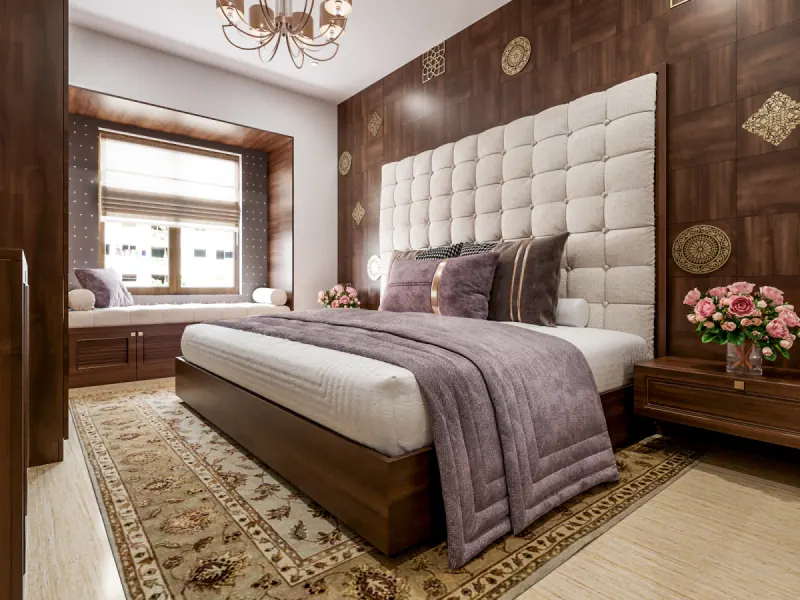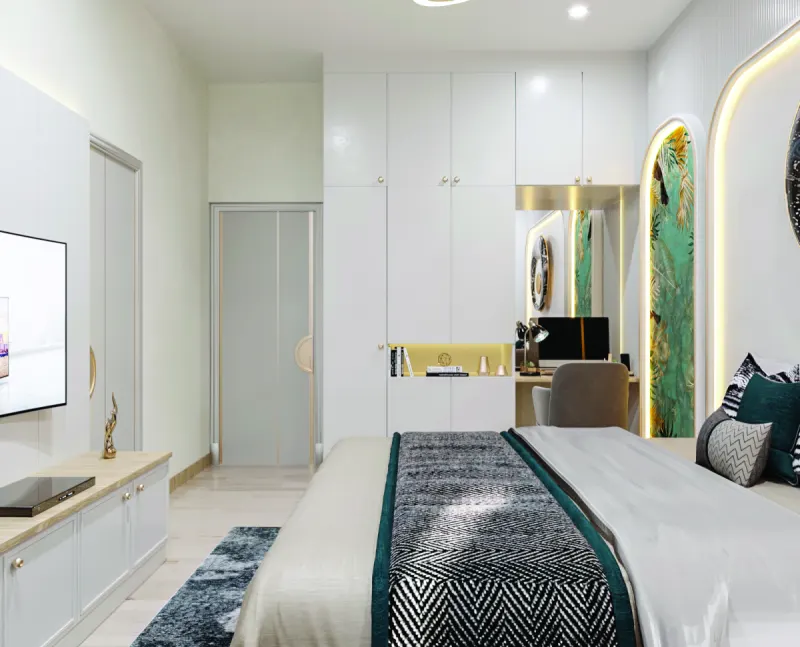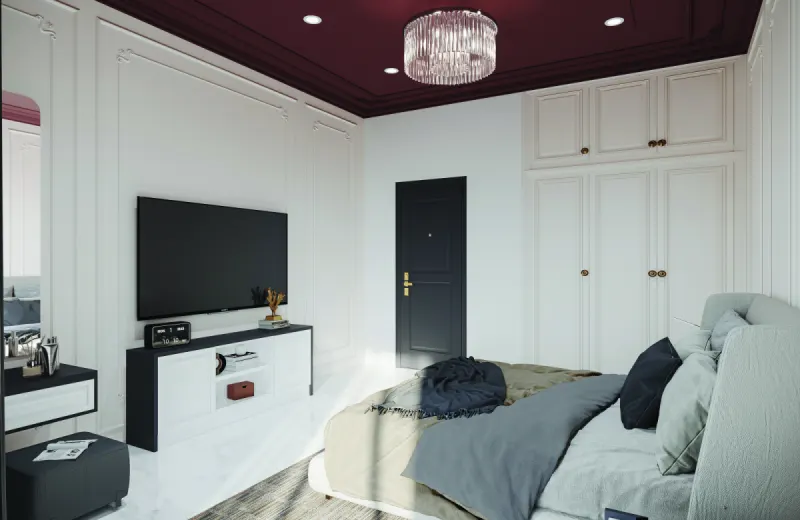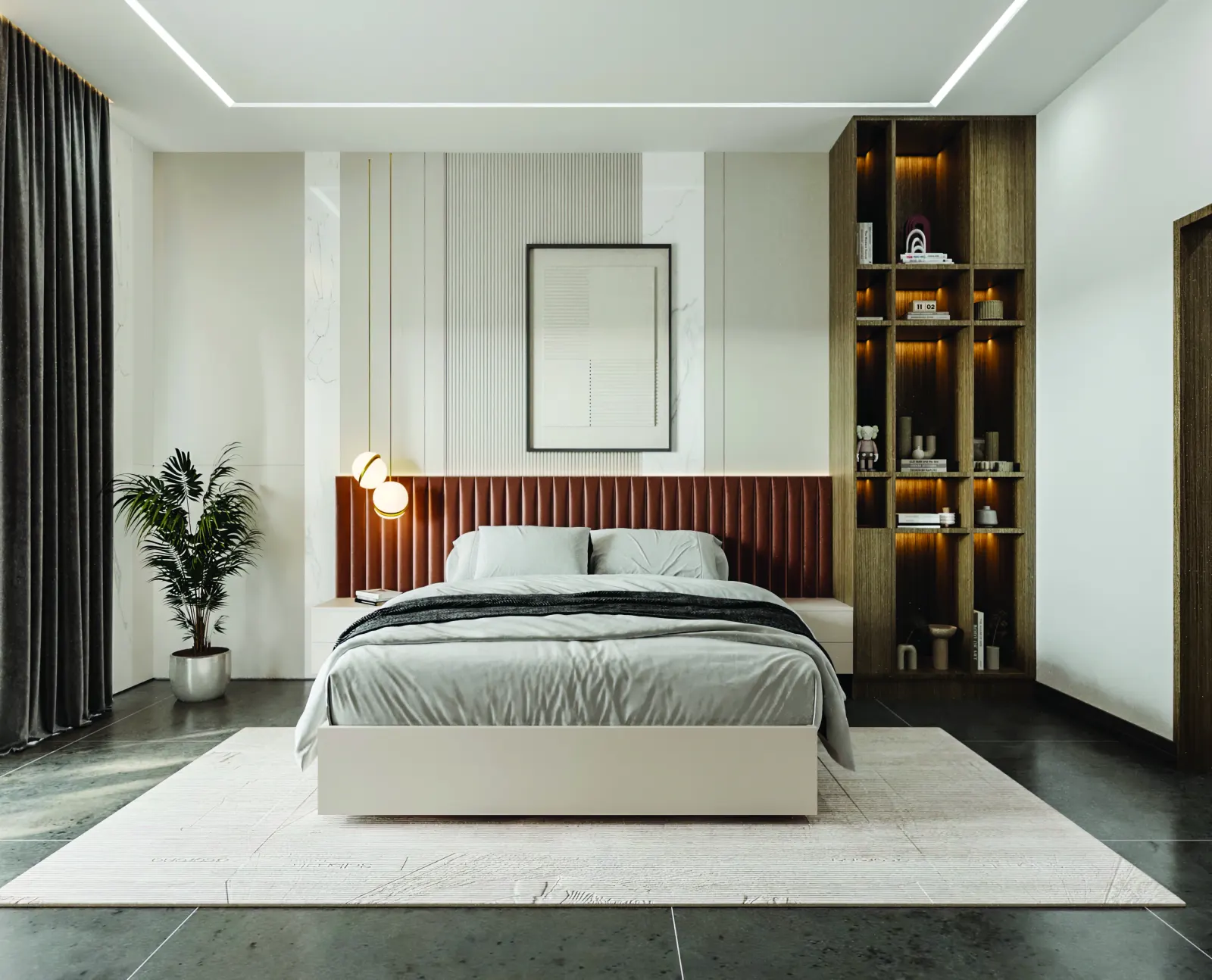
The bedroom wall behind your bed does more work than any other surface in your home. It's what you see when you enter the room, what frames your bed in photos, and what your eye rests on for the last few minutes before sleep. And yet, it's the surface most Indian homeowners under-plan — a leftover coat of paint from the flat handover, a stock wallpaper picked from a showroom catalogue, or nothing at all.
This guide brings together 35 bedroom wall designs we actually build for Bangalore homes. They're grouped by how people naturally shortlist — by style, by material, by feature, and by how the wall integrates with other bedroom elements like wardrobes or headboards. Every design carries a theme, a working brief, four practical specs (ideal room size, interior style, materials, maintenance), an honest price range in rupees per square foot, and a lifestyle tip explaining where the design actually works.
Price note: All prices are Huma Interiors factory-direct rates for July 2026, quoted per square foot of wall coverage, including material, hardware, finish, factory production, delivery within 30 km of Chandapura, and installation. Retail showroom prices for equivalent builds typically run 25–35% higher. A "standard feature wall" in most Bangalore bedrooms is 10 ft wide × 9 ft high = 90 sqft.
Why the bedroom wall matters more than you think
A well-designed feature wall does four things that flat paint cannot. It anchors the room visually — every other element (bedside tables, wardrobe, ceiling) reads in relation to it. It changes perceived room size — vertical fluted panels make ceilings appear taller, dark full-height cladding compresses a room, mirrored walls double perceived depth. It controls the light story — matte textures absorb harsh Bangalore afternoon light, LED-integrated walls provide task lighting without ceiling glare. And it establishes the emotional tone — soft upholstered padding reads as intimate, exposed brick as raw, marble as formal.
Beyond the visual, Bangalore-specific climate factors matter. The city's 65–80% humidity range over the year means unsuitable materials (particle board, MR-grade plywood behind bathrooms, low-grade wallpaper adhesive) will fail within 3–5 years. Apartments in Whitefield, Sarjapur Road and Electronic City sit close to arterial roads, so acoustic dampening from upholstered or fabric walls can measurably improve sleep quality. And Karnataka's power stability makes LED-integrated wall designs a genuine long-term investment, not a novelty.
Quick price guide by wall design type
Before the design sections, here is what different bedroom wall designs cost in Bangalore as of 2026. Prices are per square foot, factory-direct, installed. Use this table to narrow the sections you actually need to explore in detail.
| Design type | Price per sqft | Standard 90 sqft wall | Best for |
|---|---|---|---|
| Textured paint (lime wash, sand finish) | ₹450 – ₹700 | ₹40,500 – ₹63,000 | Rental homes, budget builds |
| Wallpaper on skimmed base | ₹550 – ₹1,200 | ₹49,500 – ₹1,08,000 | Quick refreshes, pattern lovers |
| Fluted MDF panels (basic) | ₹850 – ₹1,200 | ₹76,500 – ₹1,08,000 | Contemporary and modern styles |
| Wainscoting / decorative moulding | ₹950 – ₹1,400 | ₹85,500 – ₹1,26,000 | Classic and traditional bedrooms |
| Upholstered padded panels | ₹1,600 – ₹2,400 | ₹1,44,000 – ₹2,16,000 | Luxury feel, acoustic dampening |
| Premium veneer wall | ₹1,400 – ₹2,200 | ₹1,26,000 – ₹1,98,000 | Modern and master bedrooms |
| 3D sculpted / CNC MDF panels | ₹1,800 – ₹2,800 | ₹1,62,000 – ₹2,52,000 | Statement master bedrooms |
| LED backlit accent wall | ₹2,200 – ₹3,200 | ₹1,98,000 – ₹2,88,000 | Hotel-style master suites |
| Solid wood plank / marble accent | ₹2,400 – ₹4,500 | ₹2,16,000 – ₹4,05,000 | Statement heritage or luxury |
Bedroom wall designs by style (10 ideas)
Style is where most homeowners naturally start their search. The visual language of the wall has to talk to the rest of the bedroom — the wardrobe finish, the flooring tone, the ceiling treatment. These ten designs cover the aesthetic vocabularies our design team quotes for most often in Bangalore homes, from restrained Nordic minimalism to full-throated luxury hotel style.
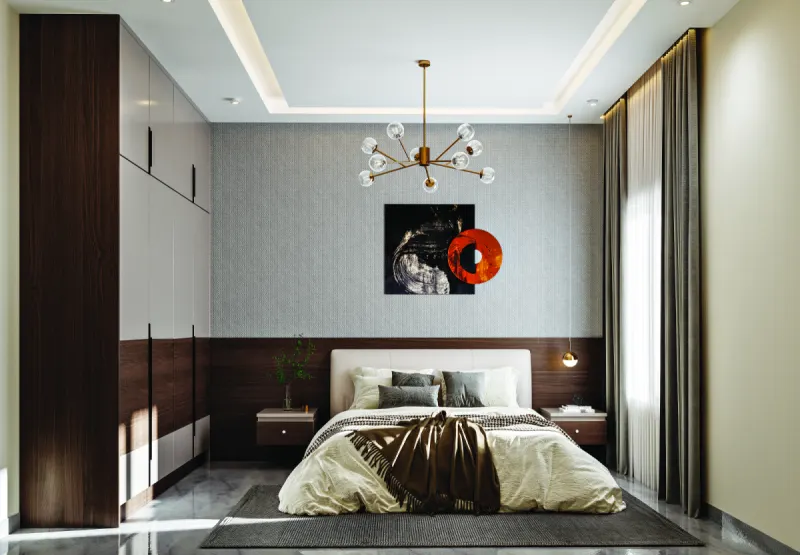
Minimalist Monochrome Feature Wall
A single-tone treatment where the feature wall carries only the subtlest texture — a whisper of vertical grooving on off-white paint, or a matte lime-wash finish in warm greige. The design deliberately withdraws so that the bed and bedside styling become the visual anchor. Bangalore homes with strong natural light suit this style best; harsh sunlight highlights any surface imperfection, so the skim coat has to be well-finished. The wall reads calm during day, dissolves into ambient light at night.
Contemporary Fluted Wood Panel Wall
Vertical fluted MDF panels in walnut, oak or teak veneer finish, running floor to ceiling behind the bed. The fluting depth (typically 15–20 mm) catches light differently through the day, giving the wall movement without pattern. This is the most-quoted feature wall design in Bangalore master bedrooms as of 2026 — it works in almost every layout, ages well, and photographs beautifully. Pair with soft warm bedside lighting to accentuate the flute shadows.
Scandinavian Half-Height Panel Wall
Wood panelling covers the lower 4 ft of the wall in light birch or pale oak, while the upper section stays crisp white. The horizontal split visually widens the room without darkening it, making this an ideal design for compact bedrooms where a full wood wall would feel heavy. A slim wooden ledge at the split line doubles as a shelf for small art or plants. Works particularly well with sheer curtains and light wood flooring.
Japandi Ash-Wood Batten Wall
Thin vertical ash-wood battens (25 mm x 40 mm) spaced 30 mm apart, running full height with a soft grey linen backing visible through the gaps. The design borrows from Japanese shoji screen aesthetics but keeps the Scandinavian warmth. A paper lantern pendant next to the bed completes the composition. This design suits homeowners who want warmth and texture without visual noise — ideal for those who meditate or read in bed.
Industrial Exposed Brick Feature Wall
A real or high-quality faux brick wall with visible mortar joints, finished with a clear matte sealer to prevent dust. The design pairs with black metal light fixtures, exposed conduit lighting, and low-slung leather or linen bedding. Genuine exposed brick works in older independent homes; for apartments, we recommend brick-slip cladding on a plywood substrate, which gives the same visual with 40% less thickness. Add a leather headboard for warmth against the raw texture.
Rustic Reclaimed Wood Plank Wall
Wide horizontal planks of reclaimed teak, salvaged from old furniture or heritage buildings, arranged with intentional variation in tone and knot pattern. Each plank tells a story of its previous life. This design suits villas and independent homes with high ceilings; in apartment bedrooms it can feel heavy. Finish with a low-VOC water-based sealer to preserve the aged tone without adding glossy artificiality. Pair with warm yellow bedside lighting.
Modern Classic Wainscoting Wall
A grid of applied moulding panels covering the full wall, painted in a single soft neutral (cream, warm grey, sage green). The panel proportions are usually 3:4 rectangles arranged symmetrically around the bed centre-line. This design has aged out of trend cycles and become genuinely timeless — it's what you see in five-star hotel rooms because it works with almost any bedding, art or wardrobe finish. Add slim brass wall sconces for a hotel-suite feel.
Luxury Hotel-Style Backlit Panel Wall
Full-height vertical panels in premium walnut or smoked oak veneer, separated by 8 mm gaps with LED strip lighting concealed inside each groove. The effect is a wall that appears to float in warm ambient light. Designed for master bedrooms where the wall itself provides all the mood lighting. Requires careful electrical planning — every panel needs a driver, dimmer and tunable warm-cool LED spec. This is one of our most-quoted premium designs.
Bohemian Cane-Weave Feature Wall
Rattan cane weave inserted into wooden frames, arranged as three or four vertical panels behind the bed. The cane's natural honey colour warms the room and its open weave breaks the flat plane of the wall without weight. Add macrame wall hangings or a woven mirror for a layered boho look. In humid Bangalore months, cane can expand slightly — proper framing with 2 mm expansion gaps prevents warping. Best paired with terracotta or muted mustard bedding.
Mid-Century Geometric Panel Wall
Diamond, hexagon or chevron pattern inlay using two contrasting wood tones — typically walnut and light oak. The geometry is precise and repeating, evoking the confident craft of 1960s furniture design. This wall makes a strong style statement, so keep the rest of the bedroom simple — tapered-leg furniture, mustard or teal bedding, and a single sculptural pendant. Not for those who repaint every three years; this is a long-commitment design.
Not sure which style suits your bedroom?
Share your bedroom photos and rough dimensions. Our design team will suggest 2–3 matching wall designs with material and price breakdowns — free, no obligation.
Bedroom wall designs by material & finish (10 ideas)
Material choice is the single biggest driver of both look and longevity. A design that reads as "premium veneer" in a rendering can end up looking cheap in laminate — or vice versa, a well-executed budget material can outperform a poorly-installed premium one. These ten designs are organised by primary material so you can shortlist based on what you actually want the wall to be made of.
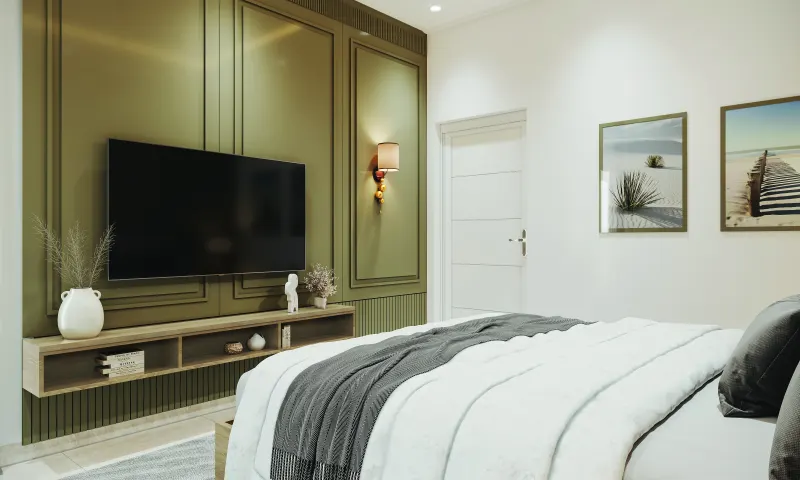
Solid Wood Vertical Slat Wall
Genuine solid wood slats — typically teak or sheesham — installed vertically with 20 mm gaps between them, mounted on a black-painted backing panel. Unlike fluted MDF, solid wood ages, develops patina, and holds its value if the home is renovated later. The gaps between slats catch shadow beautifully and improve room acoustics by breaking up sound reflection. Expensive but built for the long term.
Marble Book-Match Accent Wall
Two large marble slabs cut from adjacent portions of the same block and installed so the veining mirrors, creating a butterfly-wing pattern. Statuario, Calacatta or Panda White marbles work best for the drama. This is a serious commitment — the wall requires structural support (plywood ledger + steel anchors), waterproof sealing, and specialist installation. The reward is a wall that reads as high-end architecture rather than interior decor.
Natural Stone Cladding Wall
Slim stone tile cladding — slate, sandstone or quartz — arranged in staggered horizontal bands, giving the wall a raw natural texture without the weight of full stone. Best paired with warm dimmable lighting that skims across the surface to bring out the depth. Feels earthy and grounding, suits homeowners who want their bedroom to feel connected to nature. Not for humid corner walls that share a bathroom boundary.
Textured Lime-Wash Paint Wall
Lime-based mineral paint applied in two or three cross-hatched coats, creating a soft cloudy tonal variation on the wall. The finish photographs beautifully and reads as sophisticated European. Terracotta, warm sand, muted olive and dusty blush are the most-requested tones. The best budget-tier design — you get 80% of the visual impact of premium walls at 20% of the cost. Downside: not fully washable, so avoid in kids' rooms.
Faux Brick Panel Wall
Lightweight PU foam or high-density MDF panels textured and painted to replicate exposed brick, with real mortar joint lines. Modern faux brick has become genuinely convincing — at 2 feet away most people can't tell it apart from the real thing. Whitewashed grey brick reads Scandi-industrial, warm red brick reads loft-industrial, and painted brick (single tone) reads modern-industrial. Zero moisture worries unlike real brick.
Micro-Cement Concrete Finish Wall
A micro-cement or Venetian polished plaster finish applied in thin trowel layers, giving the wall a soft raw-concrete look without actual concrete weight. The finish is warmer than real concrete — subtle tonal variation reads as intentional, not cold. Pair with warm wood furniture and terracotta or brass accessories to soften the effect. Very durable if properly sealed; the finish can last 10+ years without any refresh.
Rattan Cane Panel Wall
Pre-woven cane panels in Vienna or octagonal weave, framed in slim solid wood borders and installed as three or four vertical modules across the wall. The weave pattern adds visual texture and light transparency — placed against a coloured backing wall, the cane reveals a subtle undertone. Requires stable humidity; Bangalore's 60–75% range is fine, but avoid installing right after monsoon when panels can be at maximum expansion.
Premium Veneer Feature Wall
Large-format veneer sheets — smoked oak, fumed walnut, or figured maple — laid up in continuous grain pattern across the wall so the wood looks like a single sheet. Higher-end than fluted panels because it uses full veneer surfaces rather than routed MDF. The best veneer walls use book-matched or slip-matched sheets from a single log so the grain pattern feels curated. Pair with matte finishes throughout the room to let the veneer be the hero.
High-Gloss Laminate Feature Wall
Ultra-gloss acrylic laminate applied as a single-tone feature wall — champagne, warm cream, deep navy or forest green work well. The reflectivity bounces light around the room, making it feel larger and brighter. Requires a perfectly flat substrate — any waviness in the plywood underneath will show clearly. Best avoided directly opposite windows unless you want a mirror-like effect throughout the day.
Decorative POP Moulding Wall
Plaster-of-Paris moulding applied in a decorative grid pattern with a top cornice, all painted in a single soft neutral. Slightly more traditional than modern wainscoting, this design references European stately-home interiors. Best executed by skilled POP artisans — the crispness of the corners is what separates a good version from a cheap-looking one. Pair with soft brass wall sconces and neutral bedding for a timeless master bedroom.
Prefer one specific material?
If you know you want veneer, marble, or fluted panels, we can quote just that. Send your wall dimensions on WhatsApp and we'll respond with an itemised estimate within 4 hours.
Bedroom wall designs by special feature (8 ideas)
Some walls earn their price through a single distinguishing feature — LED integration, mirror reflection, 3D depth, upholstered comfort. These eight designs focus on the specific feature that makes each one worth its cost, and the type of homeowner it's really for.
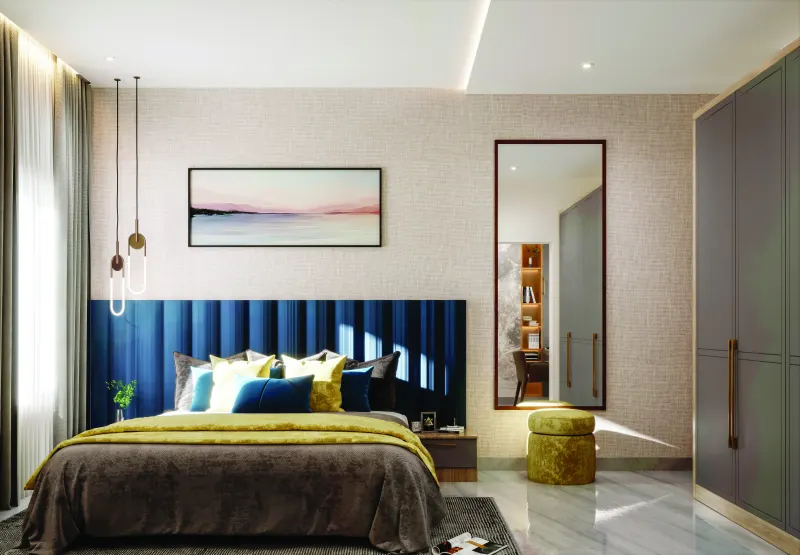
3D Sculpted MDF Panel Wall
CNC-routed MDF panels with a three-dimensional pattern — waves, ribbing, hexagons, or geometric relief — finished in a single matte tone that lets the shadow play be the star. The panels are precise, repeatable, and give the wall a genuinely sculptural presence. In Bangalore's warm afternoon light, the shadows shift through the day, making the wall look different at 10 AM versus 6 PM. Requires clean electrical planning behind the wall.
LED Backlit Accent Wall
Full-height panels with LED strip lighting concealed behind or around the edges, creating a halo effect on the wall. Dimmable, tunable warm-cool LED strips let you tune the room's mood from morning bright (4000K) to evening warm (2700K). This design replaces the need for overhead ceiling lighting entirely — one wall provides all the ambient lighting the room needs. Requires professional electrical work: dedicated dimmer circuit and quality driver.
Full-Height Mirror Feature Wall
Floor-to-ceiling mirror panels installed on the wall opposite the bed or on a side wall — never directly behind the bed for both vastu and practical reasons. In compact bedrooms this design can nearly double the perceived floor area. Antique-finish or bronze-tinted mirror sheets read more sophisticated than clear silver. The mirror surface needs edge safety framing and secure structural mounting — this is one of the few designs that must not be DIY-installed.
Statement Wallpaper Feature Wall
A single accent wall covered in high-quality non-woven wallpaper — botanical prints, geometric patterns, mural-scale landscapes, or textured grasscloth. The best wallpaper walls use European or Japanese brands (Cole & Son, Farrow & Ball, Sanderson) rather than the cheap PVC options that peel within two years. Non-woven wallpaper is repositionable, so installation defects can be fixed. Ideal for renters and homeowners who want a design change every 5–7 years.
Upholstered Padded Panel Wall
Custom-fabricated fabric-upholstered panels — plain, channel-tufted, or button-tufted — covering the full wall behind the bed. Beyond the visual richness, the fabric absorbs sound: measured tests show a 15–20% reduction in ambient noise in bedrooms facing arterial roads. Velvet reads luxurious, linen reads modern, boucle reads contemporary. Requires a stain-guard treatment during fabrication for practical longevity. Cannot be steam-cleaned.
Gallery Wall with Floating Shelves
Wall-mounted floating wooden shelves at varying heights, styled with framed art prints, small ceramics, plants, and personal collections. The design is inherently changeable — swap art seasonally, add pieces from travels. The composition follows the "salon hang" principle: dense in the middle, sparse at edges. The wall itself is painted a supporting neutral so the objects stand out. Ideal for homeowners with strong personal aesthetics.
CNC Cut Decorative Panel Wall
CNC-cut MDF or plywood panels with intricate cut-out patterns — arabesque, jaali, mandala, or custom geometric — mounted with a coloured or backlit backing that shows through the cutouts. The pattern casts shadows across the wall as light moves through the day. Bangalore homes with a South Indian or Indo-modern aesthetic often use jaali-inspired CNC patterns. Custom pattern design available for personalised motifs.
Fabric-Textured Wall Panel
Panels wrapped in linen, jute, silk-blend or grasscloth fabrics without foam padding underneath — the flat fabric surface gives a soft, quiet texture that reads sophisticated and hospitable. Different from upholstered panels (no foam, less plush), fabric-textured panels are lighter, thinner, and 30% cheaper. Best paired with wooden bedside tables, brass reading lamps, and layered neutral bedding for a Belgian-modern aesthetic.
Room-integrated bedroom wall designs (7 ideas)
The best bedroom wall designs don't stop at the wall — they extend into the wardrobe finish, wrap into the ceiling, or absorb the TV unit or bookshelf. These seven designs treat the wall as one part of a larger composition rather than an isolated feature. They typically cost more upfront but read as far more considered.
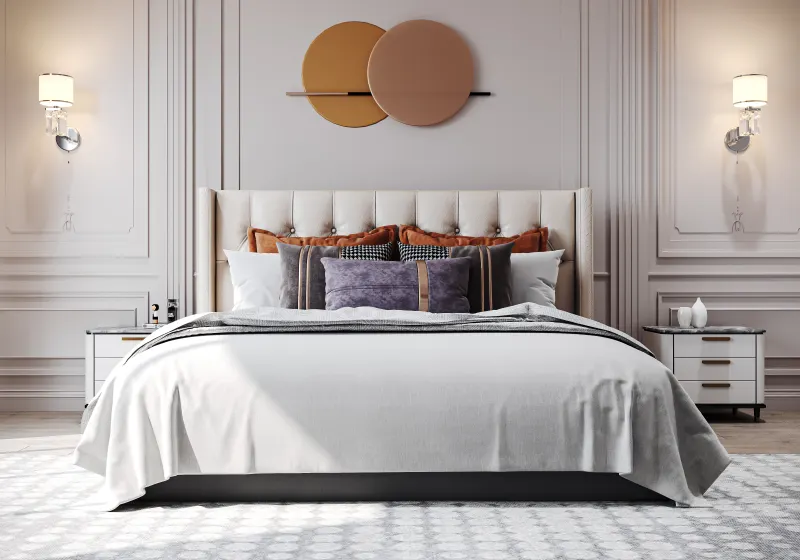
Extended Headboard Feature Wall
The headboard extends laterally to cover the full width of the bed wall — often 12–14 ft wide — with matching bedside table cabinets built into either end. The design reads as a single continuous piece rather than three separate objects (bed + two nightstands + wall). Reading lamps mount directly into the headboard extension. This is the most common request for hotel-suite-style Bangalore master bedrooms as of 2026.
Wardrobe-Integrated Accent Wall
The wardrobe finish (veneer or fluted) extends onto the adjacent bedroom wall, so the entire long wall reads as one continuous panel. The wardrobe joinery becomes almost invisible — you see wall panelling, and doors happen to be part of it. Requires the wardrobe and wall to be manufactured together for exact finish match; retrofitting rarely produces the same seamless result. Best for master bedrooms with the wardrobe wall as the longest wall.
TV Feature Wall in Bedroom
The wall opposite the bed doubles as a media wall with the TV recessed flush into panelling, cable management concealed, and LED strip backlighting behind the TV to reduce eye fatigue when watching in a dark room. The panelling extends symmetrically on either side of the TV so the screen doesn't dominate — instead it reads as part of a considered composition. Below-TV storage niche can hold streaming devices and books.
Floating Shelf Accent Composition
Three or four floating shelves in solid wood, arranged asymmetrically across the wall with hidden bracket mounts. Style with a mix of art frames, small sculptures, books stood vertically and laid flat, plants in ceramic pots, and one or two personal objects. The wall becomes both storage and display. Unlike a gallery wall, floating shelves let you re-style seasonally without any wall damage. Best for readers, collectors, plant lovers.
Nature-Themed Botanical Wall
A large-scale botanical mural or hand-painted forest scene covering the feature wall, paired with a real vertical planter or hanging plants along one edge. The line between mural and living plant blurs, making the wall feel alive. Works well for homeowners who want their bedroom to feel connected to nature — especially useful in apartment bedrooms without a view. Requires natural light or a full-spectrum grow light for the living plants.
Dual-Tone Split Wall
The wall is divided horizontally at bed-height (roughly 4 ft from the floor) into two contrasting colours or finishes — a warm terracotta lower half and pale cream upper, or dark navy lower with soft blush upper. A thin wooden ledge marks the split line and can hold small art or plants. This design is genuinely popular in 2026 — it adds interest without any material investment beyond paint. Ideal for renters.
Ceiling-to-Wall Wraparound Design
The feature wall material continues onto a portion of the ceiling directly above the bed, creating an enveloping headboard zone that feels like a private canopy. Fluted wood panels, upholstered fabric, or veneer all work for this design. The wraparound requires structural thickness planning — the ceiling section adds 40 mm to floor-to-ceiling height, so it works best when the room has at least 10 ft ceiling. Adds real hotel-suite drama.
How to choose the right bedroom wall design
Thirty-five designs is a lot to sift through. This five-step decision path removes about 80% of the options in five minutes.
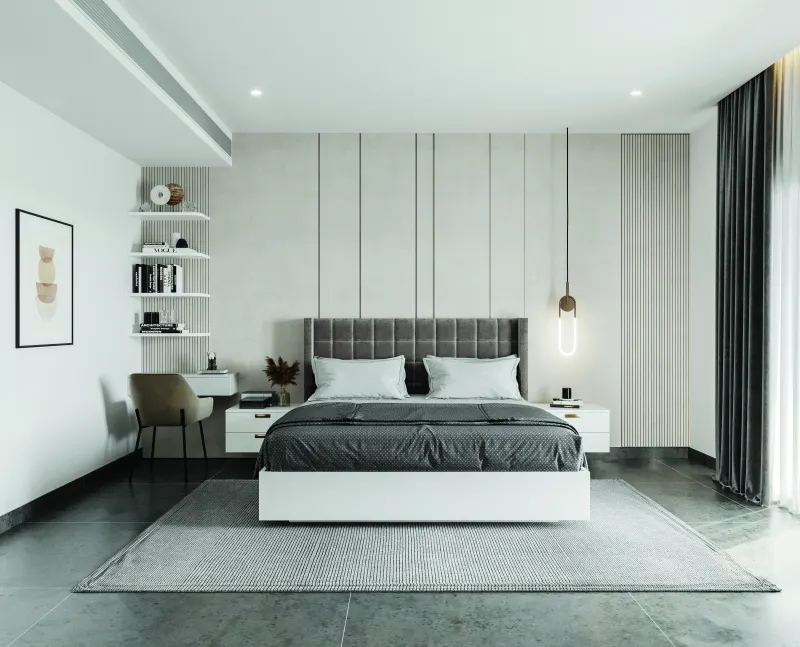
- Room size first. Under 100 sqft → light-toned, half-height, or mirror-based designs (#3, 14, 15, 19, 23, 24, 34). 100–140 sqft → most designs work (#1–34). Above 140 sqft → dramatic and integrated designs earn their space (#6, 8, 12, 25, 29, 35).
- Match the existing bedroom style. If the wardrobe is already installed, the feature wall material should either match it or intentionally contrast — never accidentally clash. Match the wood tone of the flooring within one shade lighter or darker.
- Set a wall budget. Multiply the wall area (typical 90 sqft) by your target per-sqft rate. ₹50,000 buys textured paint or basic wallpaper. ₹1 lakh buys fluted or half-height panels. ₹2 lakh buys premium veneer or upholstered walls. ₹3+ lakh buys LED backlit, marble, or wraparound designs.
- Decide on lighting integration. If you want the wall to provide ambient lighting, choose LED backlit (#22), hotel-style (#8), or 3D sculpted (#21). If ceiling and bedside lighting will do the work, skip LED integration and save 30% of the cost.
- Match to future plans. Selling or renting the home in 3–5 years → choose timeless designs (#7, 18, 20). Living in the home for 10+ years → premium materials pay back (#11, 12, 18, 22).
Materials guide — what to pick and why
Material choice determines how the wall ages, how it handles Bangalore humidity, and what percentage of the design budget goes to structure versus finish. Here is a working comparison of the substrates and finishes we use.
| Material | Lifespan | Best for | Cost impact |
|---|---|---|---|
| BWP-grade plywood substrate | 15–20 years | All finish types, humid climates | Baseline |
| Fluted MDF panels | 10–15 years | Contemporary modern designs | -5% |
| Veneer finish | 15–20 years | Premium looks, master bedrooms | +30% |
| Solid wood cladding | 25+ years | Heritage, rustic, statement walls | +120% |
| Laminate finish | 10–12 years | Budget-conscious builds | -15% |
| Marble slab | Lifetime | Luxury master bedrooms | +180% |
| Upholstered fabric | 8–10 years (re-upholster) | Luxury, acoustic requirements | +40% |
| Wallpaper (non-woven premium) | 7–10 years | Patterns, budget-friendly luxe | -40% |
Why BWP plywood matters for Bangalore homes
Bangalore's humidity range from 55% (peak summer) to 82% (monsoon) means anything less than Boiling Water Proof grade plywood is a false economy. We've replaced walls where a client saved ₹15,000 by using MR-grade plywood, only for the finish to warp within 4 years and cost ₹80,000 to redo. The 8% cost difference between MR and BWP is not worth debating. Every Huma Interiors feature wall uses BWP substrate as standard.
Fluted MDF vs solid wood — the real tradeoff
Fluted MDF panels look nearly identical to fluted solid wood at 40% of the cost. The tradeoffs: solid wood ages (patina, mellowing tone), holds a screw better if you need to remount anything, and photographs marginally warmer. MDF is more dimensionally stable in humidity swings, costs less, and lets you get more elaborate design (curved fluting, mixed-depth flutes) that solid wood cannot deliver. For most Bangalore master bedrooms, well-executed fluted MDF is the right answer.
Space planning by bedroom size
Where the wall design sits in the bedroom depends on the room size. Use these placement rules as starting points based on your bedroom dimensions.
Small bedroom (under 100 sqft)
Feature wall goes behind the bed. Keep it light-toned — off-white lime wash, half-height panels, or wallpaper in vertical patterns. Avoid dark full-height wood, heavy 3D texture, or busy patterns that will visually compress the room. A full-height mirror on the wall opposite the bed makes the room feel 30% larger, and is the single most impactful design for compact rooms.
Standard bedroom (100–130 sqft)
You have flexibility. The wall behind the bed remains the feature wall in almost all cases. Fluted MDF (#2), veneer (#18), or dual-tone (#34) all work in this size. Skip the ceiling wraparound (#35) unless your ceiling height is 10 ft or more. Position bedside tables 12–18 inches wider than the bed on each side so the feature wall reads as a framed composition.
Master bedroom (140+ sqft)
All designs in this guide are available to you. The room can carry the ceiling wraparound (#35), LED backlit hotel-style (#8), marble accent (#12), or wardrobe-integrated (#30) designs. Consider whether the design should extend into the wardrobe wall for continuity — this is where a full design team consultation earns its cost, because getting the material match right across wall, wardrobe, and ceiling requires factory-side coordination.
Expert tips from the Huma Interiors design team
These are the practical lessons our design team has picked up from over 300 completed Bangalore bedroom projects — the kind of details that don't show up in a design catalogue but make the difference between a wall that ages well and one that dates within two years.
Painting one wall a bold colour without any material change is the fastest-dating "feature wall" choice. What looked bold in 2020 (navy accent behind bed) reads flat by 2026. If your budget doesn't allow material change, invest instead in soft two-tone split (#34) or textured lime wash (#14) — both age far better than a solid coloured accent wall.
Retrofitting LED into an existing wall never looks as clean as designing it in from the start. LED strip depth, driver location, dimmer switch position, and heat dissipation all need planning before the panels are cut. If you might want LED integration ever, decide before installation — adding it later costs 2–3x more and rarely looks seamless.
Most homeowners try to match the feature wall to the flooring tone. The wardrobe finish is usually closer to eye level and reads more strongly. If your wardrobe is walnut veneer, keep the feature wall in the same or a slightly lighter walnut. The floor can be a different tone entirely without disrupting the composition.
Making the wardrobe wall your feature wall almost always fails visually — the wardrobe joinery (door lines, handles, gaps) breaks up the feature design. Feature the wall behind the bed. If you have limited wall real estate and the wardrobe wall is your longest wall, use wardrobe-integrated (#30) so the wall and wardrobe read as one.
Vertical fluted panels (#2), tall vertical slats (#11), and floor-to-ceiling mirrors (#23) all draw the eye up and make ceilings feel taller. In rooms with 9 ft ceilings, use these confidently. In rooms with 8 ft ceilings, vertical patterns can feel cramped rather than tall — horizontal designs (half-height panel #3, dual-tone split #34) often work better.
Common mistakes to avoid
These are the seven mistakes we see most often in Bangalore bedroom wall projects — the ones that cost homeowners time, money, or design regret. Reading through these before you commit saves painful correction later.
Making the wall too busy
Fluted panels + wallpaper + LED strip + geometric art all on one wall reads as chaos, not luxury. Pick one visual mechanism (texture, colour, or light) and let it do the work.
Ignoring humidity in material choice
MR-grade plywood, low-quality wallpaper adhesive, and untreated fabric panels fail within 3–4 years in Bangalore's humidity swings.
Full-wall mirrors behind the bed
Beyond vastu concerns, mirrors behind the bed reflect movement all night and can affect sleep quality. Also amplifies fingerprints and dust visibility.
Skimping on the substrate
Beautiful veneer or laminate on a warped or low-grade substrate telegraphs every imperfection. Homeowners are shocked when their premium finish looks cheap 6 months in.
Retrofitting LED after installation
LED added to an existing wall shows visible driver boxes, extra wiring routes, and rarely aligns cleanly with panel joints.
Chasing trends over timelessness
The pastel colour-block, the pink velvet channel-tuft, or the giant floral wallpaper that looked incredible in 2022 already reads dated. Trend-chasing walls cost the same but need replacement sooner.
Not planning bedside lighting
A beautiful feature wall with two harsh overhead lights looks worse than plain paint with proper bedside sconces. Wall lighting is 50% of the wall design's impact.
Vastu considerations for bedroom walls
Vastu shastra is a factor for many of our Bangalore clients, particularly for master bedroom decisions. Here are the vastu principles that intersect with wall design, drawn from what our design team has heard from clients across 100+ projects.
The headboard should sit against the south or west wall so that when you sleep, your head points south and feet point north. That wall then becomes the natural feature wall. Placing the feature wall on the north or east wall creates a conflict with vastu-preferred bed positioning.
Avoid mirrors that directly face the bed — the reflection is considered disruptive to sleep energy. If you want a mirror wall (#23), place it on a side wall angled slightly, or on the wall behind the bed where it faces the opposite direction.
Colour palette matters. Vastu-favourable feature wall colours are earthy tones — warm terracotta, sand beige, muted olive, soft brown, dusty rose. Colours discouraged for the dominant feature wall include stark black, aggressive red, and deep grey — used sparingly as accent within a design, they're fine, but not as the primary wall colour.
The wall directly behind the bed should be solid, not covered in floating shelves or a fragmented gallery arrangement. This provides symbolic support during sleep. Extended headboards (#29) and full-panel designs (#2, #7, #18) align well; gallery walls (#26) work better on side walls in vastu-conscious bedrooms.
Avoid heavy overhead elements above the bed — massive ceiling-wraparound designs (#35) can feel oppressive from a vastu perspective. Homeowners who want the wraparound aesthetic in a vastu-focused home usually adapt it to a lighter treatment on the ceiling portion.
Care & maintenance
Different wall designs need different care rhythms. Here are the care patterns for each major material category, based on what our warranty team recommends.
- Fluted MDF and veneer panels: Soft-brush dust monthly, wipe down with a barely-damp microfibre cloth quarterly. Avoid all-purpose sprays and glass cleaner. If the finish is PU-coated, an annual light wax polish extends the finish life.
- Solid wood walls (planks, slats, cladding): Vacuum dust quarterly. Apply teak oil or natural wood polish once every 18–24 months. Avoid silicone-based sprays which build up and dull the finish.
- Upholstered padded panels: Vacuum with a soft brush attachment weekly. Blot spills immediately with a dry white cloth — never rub. Professional upholstery cleaning every 12–18 months. Avoid steam cleaning which loosens the foam-fabric bond.
- Wallpaper: Dust with a dry microfibre monthly. Spot-clean marks with a lightly damp cloth immediately. Do not scrub. Non-woven wallpaper can generally be gently wiped; paper-based cannot.
- Marble and stone cladding: Dust and wipe with pH-neutral cleaner monthly. Reseal every 2 years for marble, every 3 years for slate or sandstone. Avoid acidic cleaners (vinegar, lemon) which etch marble permanently.
- LED-integrated walls: Wipe LED strip covers gently quarterly. Have an electrician check the driver every 3 years — most driver failures are the reason LED walls "die" prematurely.
Frequently asked questions
What is the cost of a bedroom wall design in Bangalore?
Bedroom wall design costs in Bangalore start at ₹450 per sqft for textured paint and go up to ₹4,500+ per sqft for solid wood or marble accent walls. Fluted MDF panels average ₹850–1,200/sqft, veneer walls sit at ₹1,400–2,200/sqft, and upholstered padded walls at ₹1,600–2,400/sqft. For a standard 10x10 feature wall, expect ₹45,000 for entry-level designs and ₹2.2 lakh for premium finishes. Factory-direct pricing removes retail markups, keeping Huma Interiors quotes 25–35% below typical showrooms.
Which wall in a bedroom should be the feature wall?
The wall behind the bed (headboard wall) is the standard choice for a feature wall in 90% of Indian bedrooms. It becomes the visual anchor when you enter the room and doesn't compete with windows for natural light. In bedrooms with a strong window view or unusual layout, the wall opposite the bed (facing wall) works as an alternative. Avoid making a wall with a door or a small window into the feature wall — the interruption breaks the design flow.
What is the best material for a bedroom accent wall?
BWP-grade plywood with a laminate, veneer or fluted MDF finish is the most balanced choice for Bangalore's humid climate. It resists warping, holds hardware well, and lasts 15–20 years. Solid wood suits heritage and rustic styles but costs 2–3x more. Wallpaper and textured paint are lowest-cost options but need replacement every 5–7 years. Avoid particle board and MR-grade plywood behind humidity-facing walls.
How much does a wooden wall panel cost for a bedroom in Bangalore?
Wooden wall panels in Bangalore range from ₹850 per sqft for basic fluted MDF panels to ₹3,200 per sqft for premium teak or walnut veneer with LED backlighting. A standard 10x9 ft feature wall in fluted MDF costs around ₹78,000 fully installed. Solid wood plank walls start at ₹2,400/sqft, and premium book-matched veneer walls at ₹2,000/sqft. Huma Interiors uses BWP-grade plywood substrate under all wooden panelling for humidity resistance.
How to choose bedroom wall design for a small bedroom?
For bedrooms under 100 sqft, use light-toned wall designs — off-white fluted panels, cane inlay, or half-height wainscoting — to keep the visual footprint light. Avoid dark wooden panels covering full walls, heavy 3D textures, or busy wallpapers, which visually shrink the space. Vertical patterns (fluted panels, wainscoting) make ceilings appear taller. Full-height mirror feature walls also work well in compact rooms by bouncing light and doubling the perceived depth.
Is fluted wall design still trending in 2026?
Yes. Fluted wall panels have moved from a trending style to a mainstream standard in Indian bedroom interiors — we quote for them in roughly 4 out of 10 Bangalore bedroom projects as of 2026. The style has matured beyond plain vertical MDF flutes to include mixed-material combinations (fluted wood with brass inlay, fluted panels with LED backlighting), curved fluted returns, and two-tone contrast fluting. As long as bedroom design values texture over flat colour, fluted walls will remain relevant.
How long does it take to install a bedroom wall design?
Site installation for a bedroom accent wall takes 2–5 days depending on the design. Fluted panels, veneer walls and laminated features install in 2–3 days. Upholstered padded walls take 3–4 days. LED backlit and CNC panels take 4–5 days including wiring and finishing. Custom builds from Huma Interiors add 15–20 days of factory production before site installation, so plan for a 20–25 day total timeline from design confirmation to a completed wall.
What are the vastu rules for bedroom walls?
Vastu shastra recommends placing the bed's headboard against the south or west wall, which then becomes the natural feature wall. Avoid mirrors directly facing the bed on any wall — they should sit at an angle. Earthy tones (terracotta, warm beige, soft green, muted brown) are preferred over stark whites or aggressive reds for the feature wall. Bright red, black or dark grey as the dominant feature-wall colour is traditionally discouraged in vastu-focused bedroom designs.
Do bedroom wall designs from Huma Interiors come with a warranty?
Yes. Huma Interiors covers all custom wall panelling and feature walls under a warranty of up to 10 years (5 years as standard). The warranty covers structural integrity, laminate/veneer bonding, LED strip functionality and hardware. Surface wear from cleaning agents, water damage from wall seepage, and modifications after installation are not covered. Wallpaper, textured paint and upholstered fabric surfaces carry a 2-year warranty limited to installation defects.
Can I install a bedroom wall design in a rental home?
Yes, but stick to reversible options. Peel-and-stick wallpaper, removable wall decals, freestanding panelled headboards, and unfixed floating shelves are all rental-friendly. Avoid drilled panels, wet cladding (stone, marble), or wired LED walls, since these require restoration on move-out. If the tenancy is 3+ years, some Huma Interiors clients invest in modular fluted panels that dismount cleanly and can be reinstalled in the next home.
Ready to design your bedroom wall?
Every design in this guide is available as a factory-direct custom build. Our design team will visit your home for on-site measurement, prepare 3D visualisation matched to your bedroom's existing furniture and lighting, and quote a firm price within 48 hours. All work is backed by Huma Interiors' structural warranty of up to 10 years. There is no obligation after the quote, and the design consultation itself is free.
For a starting point, the three most popular designs among our 2026 Bangalore bedroom projects have been the fluted wood panel wall (#2), the extended headboard feature wall (#29), and the LED backlit accent wall (#22). Between them, they cover the majority of modern master bedroom preferences at three different price points.