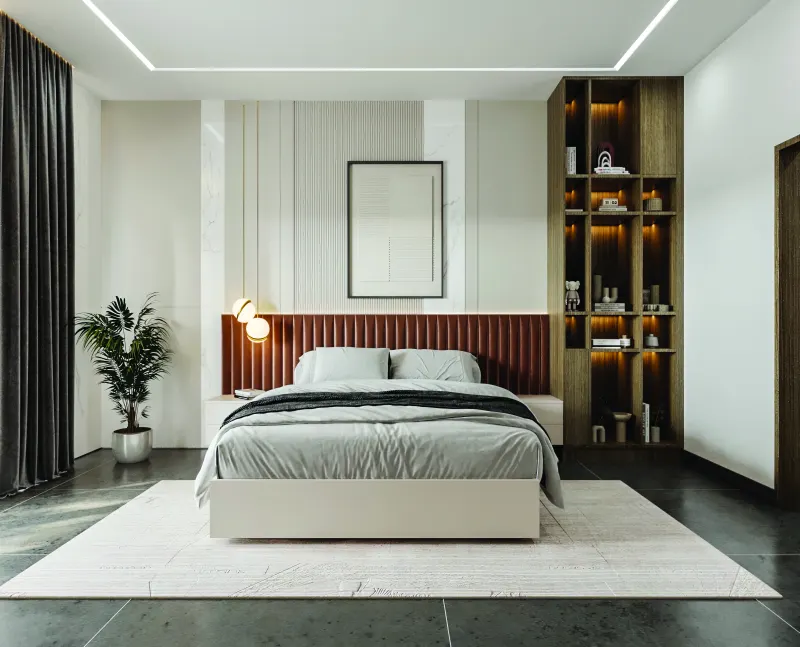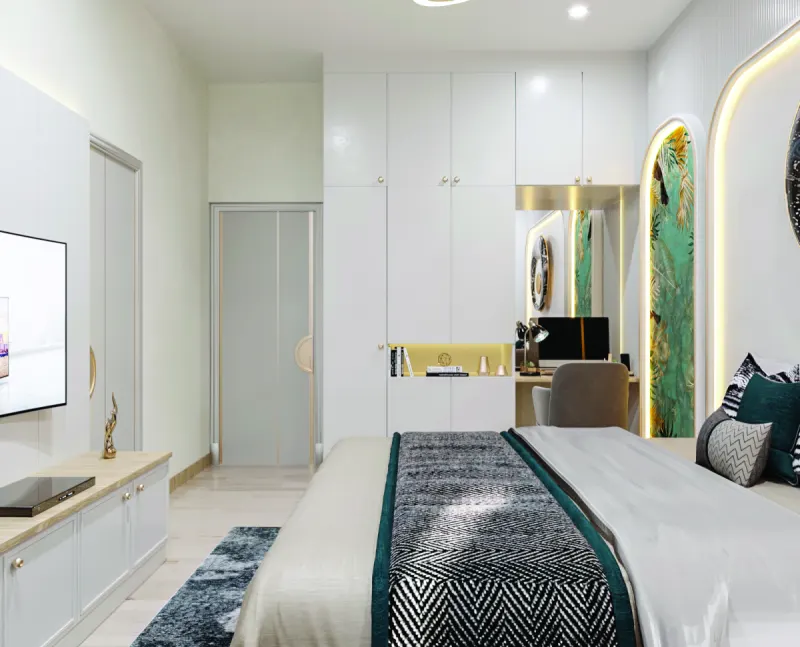
Sliding wardrobes are what most Bangalore apartments actually need. A hinged wardrobe eats 20–24 inches of floor space every time you open a door — an unforgiving cost in bedrooms where the bed-to-wardrobe gap is already tight. Sliding doors take up zero swing space. The panels stay flush with the wardrobe body whether closed, open, or halfway. In a 100 sqft bedroom, that difference decides whether the room feels tight or comfortable.
This guide brings together 35 sliding wardrobe designs our team builds for Bangalore homes, organised by how buyers naturally shortlist — by style, by door material, by layout, and by special features. Each design carries a theme, a working 100–130 word brief, key specs (bedroom size, door mechanism, materials, hardware, storage capacity), pros and cons, and a lifestyle tip explaining who the design is actually for. We also cover what nobody in Page 1 of Google covers well — the sliding mechanism itself, which is what actually decides whether your wardrobe still works smoothly in year 10.
Price note: All prices are Huma Interiors factory-direct rates for July 2026, including material, sliding mechanism (Hettich or Ebco), hardware, glass/mirror where applicable, finish, factory production, delivery within 30 km of Chandapura, and installation. Retail showroom prices for equivalent builds typically run 25–35% higher. Prices below are quoted per-square-foot of front-face area or per-unit for standard configurations.
Why sliding wardrobes matter in Indian bedrooms
Sliding wardrobes solve four problems that hinged wardrobes cannot. First, they eat zero floor swing space. In a bedroom under 130 sqft where the bed is 5–6 feet from the wardrobe wall, a hinged door swinging open makes the room feel cramped. A sliding door doesn't. Second, they enable full-wall coverage — a 12-foot floor-to-ceiling sliding wardrobe is entirely feasible; a hinged version of the same would need extreme swing space to work. Third, they support glass and mirror fronts at a scale that hinged wardrobes cannot safely handle. Fourth, they make wardrobes look like architecture rather than furniture — the flat door plane reads as part of the wall.
Bangalore-specific factors also matter. The city's 55–82% humidity swing means the sliding mechanism has to be corrosion-resistant, which is why cheap Chinese track systems fail here within 3 years. Apartments in Whitefield, Sarjapura Road, Electronic City and HSR Layout typically have master bedrooms of 100–150 sqft where sliding is the objectively better choice, and 2BHK secondary bedrooms of 80–100 sqft where sliding may be the only choice that works.
Quick price guide by wardrobe type
Sliding wardrobes are priced two ways in Bangalore — per-square-foot of front-face area, and per-unit for standard configurations. Both are useful references. Prices below are Huma factory-direct rates, including sliding mechanism and installation.
| Configuration | Standard price | Per sqft equivalent | Best for |
|---|---|---|---|
| 6 ft × 7 ft — 2-door laminate | ₹56,000 – ₹78,000 | ₹1,300 – ₹1,850/sqft | Compact 2BHK, guest bedrooms |
| 8 ft × 7 ft — 3-door laminate | ₹78,000 – ₹1,15,000 | ₹1,400 – ₹2,050/sqft | Standard 2BHK/3BHK master |
| 8 ft × 7 ft — 3-door with mirror | ₹1,05,000 – ₹1,45,000 | ₹1,875 – ₹2,600/sqft | Bedrooms without dressing table |
| 8 ft × 7 ft — 3-door veneer | ₹1,25,000 – ₹1,80,000 | ₹2,230 – ₹3,210/sqft | Premium 3BHK master |
| 10 ft × 8 ft — 4-door with loft | ₹1,40,000 – ₹2,20,000 | ₹1,750 – ₹2,750/sqft | Master bedrooms with high ceilings |
| 12 ft × 8 ft — Floor-to-ceiling | ₹1,80,000 – ₹2,80,000 | ₹1,875 – ₹2,915/sqft | Premium master bedrooms, villas |
| 10 × 8 ft — Solid wood premium | ₹2,20,000 – ₹3,20,000 | ₹2,750 – ₹4,000/sqft | Heritage-style master bedrooms |
| Walk-in — 100 sqft footprint | ₹2,80,000 – ₹5,00,000+ | Custom quote | Villa suites, premium 4BHK |
Sliding wardrobe designs by style (10 ideas)
Style is where most buyers start their shortlist — the wardrobe finish has to talk to the bedroom's flooring, wall design and bed. These ten designs cover the aesthetic vocabularies our team quotes for most often in Bangalore, from restrained minimalism to full-height premium veneer.
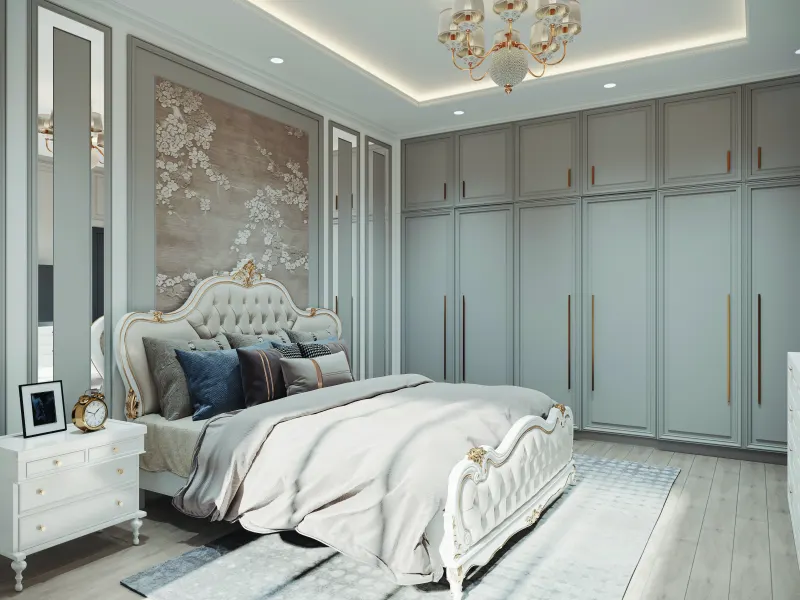
Minimalist White Handleless Sliding Wardrobe
An 8-foot 3-door sliding wardrobe in warm white matte laminate with recessed finger-pull grooves instead of handles. The flat facade reads more like architecture than furniture — no protruding hardware, no visual noise. Ideal for compact bedrooms where the wardrobe wall should recede quietly rather than dominate. Interior kept simple with two hanging rods, a shelf tower and 4 drawers. Best paired with light wood flooring and neutral wall paint.
Modern Fluted Panel Sliding Wardrobe
An 8-foot 3-door sliding wardrobe with vertical fluted MDF panels in walnut veneer finish. The fluting depth of 15–20 mm catches light differently through the day, giving the wardrobe texture without pattern. Most-quoted premium sliding wardrobe in Bangalore master bedrooms in 2026 — versatile, ages well, photographs beautifully. Interior includes tie/belt organiser, pull-out pants rack and a jewellery drawer with velvet inserts.
Scandinavian Light-Oak Sliding Wardrobe
An 8-foot 3-door sliding wardrobe in pale oak veneer with narrow black metal handle strips running vertically. The light wood tone keeps the bedroom visually open — critical in compact spaces where a dark wardrobe would compress the room. Interior organised around simplicity: two long-hang rods, adjustable shelving, and a shallow drawer bank. Best paired with white walls, sheer curtains and warm textile bedding.
Japandi Slim-Profile Sliding Wardrobe
An 8-foot 3-door sliding wardrobe in ash wood with linen-fabric inlay panels on the central door. The design references Japanese shoji screens and Scandinavian restraint together — quiet, considered, warm. Handles are minimal wooden tab pulls. Interior focuses on clean organisation with dedicated zones for folded items, hanging clothes and small accessories. Best in bedrooms where the design language is intentional and calm.
Industrial Black-Frame Glass Sliding Wardrobe
An 8-foot 3-door sliding wardrobe with black powder-coated aluminium frames and clear or frosted glass panels. The design references Crittall-style windows and factory sliding doors. Interior includes internal LED strip lighting that illuminates the contents through the glass — the wardrobe becomes both storage and evening ambient lighting. Best in modern master bedrooms with grey or exposed-concrete accent walls.
Contemporary Two-Tone Sliding Wardrobe
An 8-foot 3-door sliding wardrobe combining warm oak veneer on the outer doors with a deep navy blue PU-lacquer centre door — or terracotta with cream, forest green with sand. The material contrast reads considered rather than random and adds personality without pattern. One of the most-quoted designs among design-forward homeowners in Bangalore 3BHKs looking for something beyond plain finishes.
Modern Classic Panel-Detail Sliding Wardrobe
An 8-foot 3-door sliding wardrobe with applied moulding rectangles on each door, painted a single soft neutral (cream, sage green, or warm grey) with antique brass finger-pulls. Design references five-star hotel wardrobes — restrained, symmetrical, timeless. The panel detail avoids the trend cycle that plain flat doors go through every 5 years. Best in bedrooms where the design should hold its style for a decade or more.
Suite-Grade Backlit Sliding Wardrobe
A 10-foot 4-door full-height sliding wardrobe in smoked oak veneer with LED strip lighting concealed around each door frame, creating a warm ambient glow when closed. Interior includes climate-controlled shoe drawer, felt-lined jewellery organiser, motorised tie rack and hidden safe compartment. Designed for master bedrooms where the wardrobe is a permanent architectural piece. Requires professional electrical planning and dedicated dimmer circuit.
Mid-Century Warm-Walnut Sliding Wardrobe
An 8-foot 3-door sliding wardrobe in warm rich walnut veneer with a subtle angled edge detail on each door — referencing the tapered forms of mid-century modern furniture. Handles are slim brass pulls angled 15° for tactile character. Interior includes a felted watch drawer and specialised organisers referencing 1960s bedroom design. Best in bedrooms where mid-century furniture (Eames chair, walnut nightstand) is already present.
Boho Cane-Insert Sliding Wardrobe
An 8-foot 3-door sliding wardrobe with natural rattan cane inserts in the central section of each door, framed in solid wood. The cane pattern adds textural warmth and lets a hint of the interior show through, softening the visual weight of the wardrobe. Best in bohemian and coastal-style bedrooms. Cane requires proper framing with 2 mm expansion gaps to handle Bangalore's humidity swings; installation timing matters — avoid right after monsoon.
Not sure which style fits your bedroom?
Share your bedroom photos and rough dimensions. Our design team will suggest 2–3 matching sliding wardrobe designs with material and price breakdowns — free, no obligation.
Sliding wardrobe designs by door material (10 ideas)
Door material drives 60% of the visual identity and 40% of the cost. Glass and mirror doors give the wardrobe an entirely different presence from wood or laminate — they bounce light and add depth. Solid wood adds heritage weight. These ten designs are organised by primary door material.
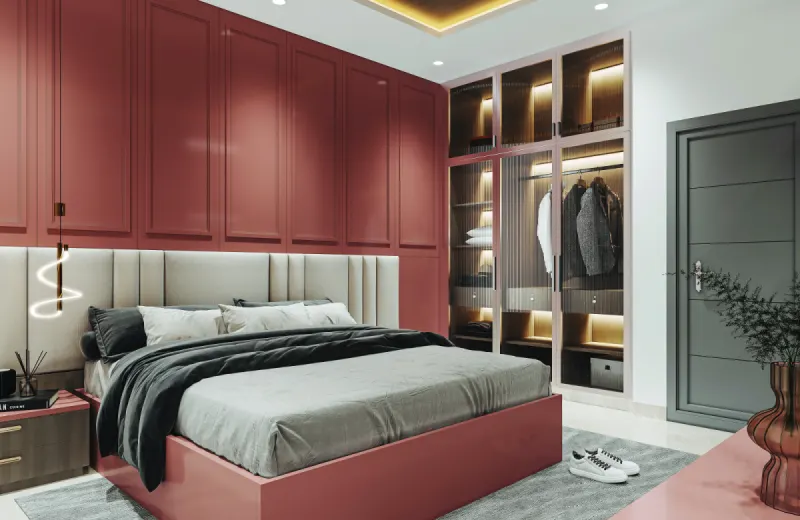
Frosted Glass Sliding Wardrobe
An 8-foot 3-door sliding wardrobe with fully frosted acid-etched tempered glass panels in aluminium frames. The frosted glass softens what's inside — you sense the arrangement without seeing details clearly. Ideal for homeowners who don't want fingerprint-showing clear glass but still want visual lightness. Interior LED strip provides gentle backlighting through the frosted surface. Glass edges are always polished — never leave raw.
Lacquered Glass Sliding Wardrobe
An 8-foot 3-door sliding wardrobe with back-painted tempered glass — the paint applied to the reverse side gives depth and a mirror-like reflective quality without the actual mirror. Available in champagne, deep navy, forest green, blush pink, and warm cream. The finish is scratch-resistant, wipes clean effortlessly, and doesn't fade in Bangalore sun. More vibrant colour options than PU lacquer at 20% lower cost.
Mirrored Sliding Wardrobe
An 8-foot 3-door sliding wardrobe with full-length mirrored doors backed with PVB safety film to prevent shattering. Doubles as a dressing mirror without needing a separate one — critical space-saver in bedrooms under 120 sqft. The mirror reflection visually doubles the perceived room depth, making compact bedrooms feel far larger. Always specify safety-film backing for sliding mirrors — plain silvered mirror is not safe on a sliding door.
Fluted-Glass Sliding Wardrobe
An 8-foot 3-door sliding wardrobe with vertically fluted (reeded) tempered glass panels in slim aluminium frames. The ribbed pattern catches and refracts light through the day, softening what's behind while adding architectural texture. Doesn't show fingerprints as visibly as clear or frosted glass. Available in clear, smoked bronze and warm champagne tints. Interior LED becomes a diffused warm glow through the flutes.
Premium Veneer Sliding Wardrobe
An 8-foot 3-door sliding wardrobe with book-matched veneer panels — the grain flowing continuously across all three doors as if cut from a single log. Walnut, smoked oak, fumed ash and figured maple are common choices. The book-match technique costs 20% more than regular veneer but raises the wardrobe from furniture to architecture. Best-value premium wardrobe option — feels custom without going overboard on cost.
High-Gloss Acrylic Sliding Wardrobe
An 8-foot 3-door sliding wardrobe with high-gloss acrylic laminate finish — mirror-smooth surface that bounces light and makes the bedroom feel brighter. Ivory white, warm cream, deep navy and forest green are common choices. Acrylic is more scratch-resistant than PU lacquer and doesn't yellow with age. Best in bedrooms that need visual brightness — north-facing rooms or compact spaces without much natural light.
Matte Laminate Sliding Wardrobe
An 8-foot 3-door sliding wardrobe in matte laminate finish — warm grey, soft cream, muted olive, or slate. The best-value option in this guide: 75% of the visual effect of premium finishes at 55% of the cost. Matte laminate hides fingerprints and daily wear far better than gloss or acrylic. Available in a very wide colour palette. Best for young families, first-time home renovators, or anyone building a home on a controlled budget.
PU Lacquer Painted Sliding Wardrobe
An 8-foot 3-door sliding wardrobe with a mirror-smooth 3-coat polyurethane lacquer finish — the deepest, richest painted finish available. Deep navy, forest green, warm charcoal or classic ivory all read exceptional in PU. Requires a perfectly flat substrate; any waviness in the plywood shows in the mirror finish. Higher maintenance than laminate — shows fingerprints and small scratches, needs periodic touch-up. Feels premium to the touch.
Solid Wood Sliding Wardrobe
An 8-foot 3-door sliding wardrobe in genuine solid teak or rosewood with traditional mortise-tenon joinery. The wardrobe develops patina over decades and gets more character-rich with age. Not for a rental — this is a 30-year piece. Requires heavy-duty sliding mechanism (Hettich TopLine XL heavy-load) because door panels weigh 3x more than laminate equivalents. Ideal for heritage-style bedrooms and homes meant to be inherited.
Rattan/Cane Panel Sliding Wardrobe
An 8-foot 3-door sliding wardrobe with woven rattan or natural cane panels across the full door face, framed in solid wood. The woven texture reads warmly natural and adds a tactile quality that no other material provides. Best in coastal, bohemian and Japandi bedrooms. Cane panels need 2 mm expansion gaps to handle Bangalore's humidity, and shouldn't be installed right after monsoon when they're at maximum expansion.
Want a specific material?
If you know you want glass, mirror, veneer, or fluted — we can quote just that. Send your bedroom dimensions on WhatsApp and we'll respond with an itemised estimate within 4 hours.
Sliding wardrobe designs by layout (10 ideas)
Layout matters more for sliding wardrobes than for hinged — the door count, wardrobe width, height and configuration all affect how much you can store and how the wardrobe reads in the room. These ten designs are organised by physical configuration rather than style.
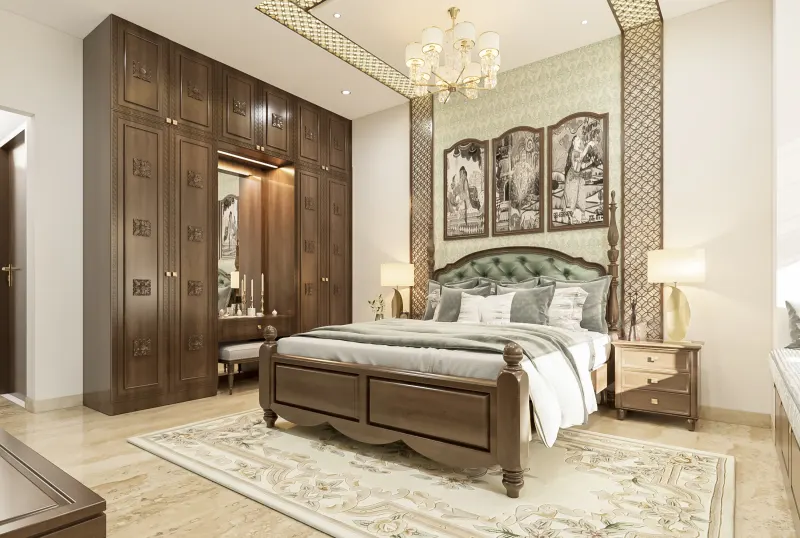
2-Door Sliding Wardrobe (Compact)
A 6-foot 2-door sliding wardrobe — smallest standard sliding configuration. Two door panels overlap so only half the wardrobe is accessible at any time. Ideal for compact 2BHK bedrooms under 90 sqft, kids' rooms, and guest bedrooms. Interior organised for essentials: single hanging rod, 4–6 shelves, 2–3 drawers. Depth 22 inches. Loft option adds 2 feet of height for seasonal storage.
3-Door Sliding Wardrobe (Standard)
An 8-foot 3-door sliding wardrobe — the most-quoted standard configuration in Bangalore master bedrooms. Three sliding panels give access to two-thirds of the interior at any time, which is a significant usability improvement over 2-door. Interior split into two hanging zones and a central shelf-and-drawer tower. Suits standard 2BHK and 3BHK master bedrooms. The default configuration if you don't have a specific requirement.
4-Door Sliding Wardrobe (Master)
A 10-foot 4-door sliding wardrobe for larger master bedrooms where extensive storage is needed. Four panels allow three-quarters of the interior to be accessed at any time, matching the usability of a hinged wardrobe. Interior includes separate his-and-hers hanging zones, a dedicated shoe drawer bank, jewellery organiser and dressing accessories. Suits master bedrooms in premium 3BHK and 4BHK apartments and villas.
Floor-to-Ceiling Sliding Wardrobe
A 10-foot 4-door sliding wardrobe extending from floor to ceiling (8–9 ft height), eliminating the dust-collecting gap above standard wardrobes and adding 30% more storage from the reclaimed vertical space. The upper zone (above 6 ft) is best for seasonal storage — bedding, off-season clothes, luggage. Requires precise ceiling-height planning during the build. Reads as architecture rather than furniture.
L-Shape Corner Sliding Wardrobe
A corner-configured sliding wardrobe with the main arm 8 feet wide and a return arm 4 feet wide, meeting at a 90° corner. The design uses the corner space efficiently and adds 30% more storage than a straight-wall equivalent. Corner section uses a rotating carousel or L-shaped hanging pole for accessibility. Best in bedrooms where two adjacent walls are both viable placement — common in 3BHK layouts.
Walk-in Sliding Wardrobe
A walk-in wardrobe room with sliding entry door and internal U-shape or parallel-shelf configuration. Typically 8×10 ft or 10×12 ft footprint. Features a central island for jewellery and folded items, full-length mirror on the entry door, and dedicated shoe wall. Requires a bedroom of 200+ sqft or a separate dressing room. Ideal for master suites in villas and premium 4BHKs. Full-organisation walk-ins can accommodate 500+ garments.
Sliding Wardrobe with Loft Storage
An 8-foot 3-door sliding wardrobe with a separate 2-foot loft cabinet above, accessed via hinged flip-up doors. The loft handles seasonal storage — winter bedding, off-season clothes, suitcases, festival items. The dedicated separation between daily-use (below) and long-term (above) zones is an ergonomic improvement over floor-to-ceiling designs. Loft depth matches wardrobe depth. Requires a step ladder for access.
Sliding Wardrobe with Integrated Dressing Table
A 10-foot combined unit with an 8-foot 3-door sliding wardrobe and an integrated 2-foot dressing table extension at one end, sharing the same finish and hardware. The dressing zone includes vanity mirror, task lighting, and 2 drawers for cosmetics. Ideal for bedrooms under 130 sqft that cannot accommodate a standalone dressing table. The continuous finish reads as a single considered piece rather than two furniture items.
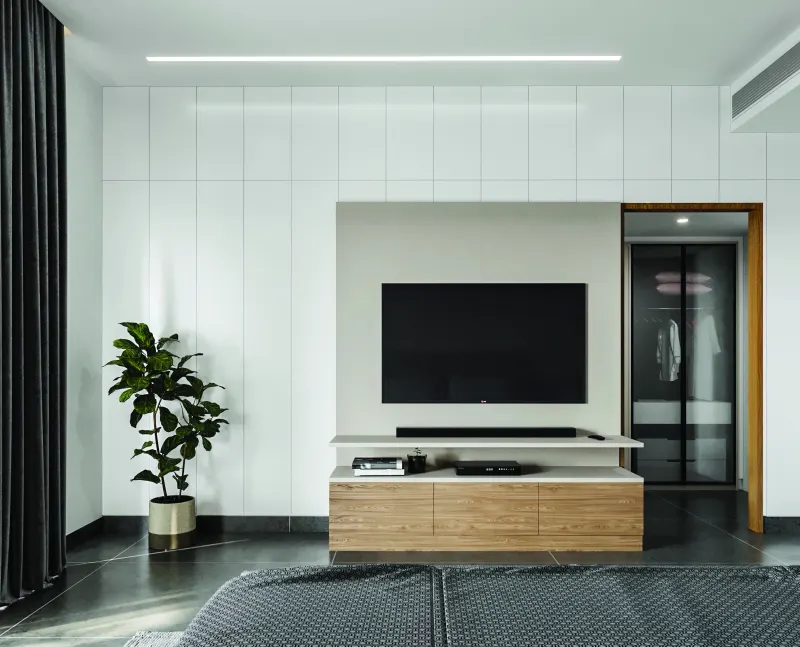
Sliding Wardrobe with TV Unit
A 12-foot combined unit with an 8-foot 3-door sliding wardrobe and a 4-foot recessed TV zone at one end, sharing the same finish. The TV is flush-mounted in the wardrobe wall with concealed cable management and a small storage drawer for streaming devices below. Ideal for bedrooms where the wardrobe wall is also the natural TV-viewing wall. Requires electrical planning during the build.
Compact 6-ft Wide Sliding Wardrobe
A 6-foot 2-door sliding wardrobe scaled for compact master bedrooms — full 7-ft height (not the reduced height of guest wardrobes) with premium interior organisation including tie rack, jewellery drawer, pants pull-out and dedicated shoe zone. Solves the compact-master problem where standard 8-ft wardrobes don't fit but a "small" 6-ft option needs to still deliver master-grade organisation.
Sliding wardrobes with special features (5 ideas)
Five feature-driven designs where the utility of a specific feature justifies its cost premium.
LED Backlit Sliding Wardrobe
An 8-foot 3-door sliding wardrobe with LED strip lighting concealed around each door frame, creating a soft ambient halo on the surrounding wall. Doubles as room mood lighting — dimmable tunable warm-cool LEDs let you tune the bedroom from morning bright to evening warm. Interior gets motion-sensor LED that turns on when doors open. Requires professional electrical planning with dedicated driver and dimmer switch.
Soft-Close Anti-Jump Sliding Wardrobe
An 8-foot 3-door sliding wardrobe fitted with the premium sliding mechanism — Hettich TopLine XL with soft-close buffers on both ends of travel and anti-jump wheel design that prevents the door from lifting off the track. The mechanism costs ₹15,000–₹25,000 more than budget alternatives but is rated for 40,000+ cycles (30 years typical use). This is what actually decides whether your wardrobe still works in year 15.
Pull-Out Drawer + Pants Rack Sliding Wardrobe
An 8-foot 3-door sliding wardrobe with full-organiser interior — pull-out pants rack, pull-out shoe drawers with vented base, jewellery organiser drawer with velvet inserts, tie rack, and cufflink tray. Every category of item has its own designed space. Higher upfront cost but substantially better daily-use experience than open shelf storage. Best for organisation-focused homeowners.
Sliding Wardrobe with Vanity Mirror Panel
An 8-foot 3-door sliding wardrobe with a full-length dressing mirror mounted on the inside of the central door — invisible when the wardrobe is closed. Add-on wall-mount LED lighting inside provides task lighting when the mirror is in use. Saves the entire dressing table footprint from the bedroom without sacrificing the dressing function. Ideal for compact bedrooms where every square foot matters.
Motorised Sliding Wardrobe
A 10-foot 4-door sliding wardrobe with motorised opening — touch or app-controlled — using Hafele Servo-Drive system. Doors glide open silently with a gentle push or a button tap. Interior includes motorised tie rack, motion-sensor LED, and a small climate-controlled shoe drawer. The highest-end option in this guide, reserved for master suites in premium villas and 4BHK homes where the wardrobe is a permanent architectural investment.
Want a specific feature combined?
LED backlit + inside vanity mirror + full organiser interior — all in one wardrobe — is possible. Send us your feature wishlist and we'll quote the combined build.
Sliding mechanisms explained — what nobody tells you
This is the section every Page 1 competitor skips. The sliding mechanism — tracks, wheels, buffers, guides — is what actually decides whether your wardrobe still works smoothly at year 10. Cheap mechanisms fail within 3 years in Bangalore's humidity; premium ones last 25–30 years. Here's the working knowledge to make an informed choice.
Top-hung vs bottom-rolling
Sliding wardrobes come in two mechanism types. Top-hung mechanisms carry the door weight on the upper track — the bottom guide only stabilises. Doors glide more smoothly and never derail. Bottom-rolling mechanisms carry weight on lower wheels — cheaper but more prone to dust build-up and eventual jamming. For Bangalore homes, top-hung is the correct choice; bottom-rolling only makes sense for very lightweight door panels.
The three mechanism brands worth using
| Brand | Model | Cycle rating | Best for |
|---|---|---|---|
| Hettich | TopLine XL | 40,000 cycles | 3–4 door master wardrobes |
| Hettich | TopLine XL Heavy | 40,000 cycles / 80kg | Glass, mirror, solid wood doors |
| Ebco | Slyder | 25,000 cycles | 2–3 door standard wardrobes |
| Hafele | SlideLine M | 30,000 cycles | Standard master wardrobes |
| Hafele | Servo-Drive | 40,000 cycles / motorised | Premium villa suites |
What to insist on in the quote
- Top-hung design — never bottom-rolling for wardrobes over 6 ft wide
- Soft-close buffers on both ends — prevents door slam
- Anti-jump wheel design — prevents door lift-off during heavy use
- Rated for door weight — glass and mirror doors need 60kg+ ratings; solid wood needs 80kg+
- Corrosion-resistant track — powder-coated or stainless steel, not raw aluminium
- Named brand in the quote — if the quote says "premium sliding channel" without a brand name, it's likely generic
The mechanism costs ₹8,000–₹25,000 depending on door count, size and brand. Trying to save ₹5,000 on the mechanism is the single most common cause of wardrobe replacement in year 5. A ₹1.5 lakh wardrobe with a ₹5,000 mechanism will fail before a ₹1.2 lakh wardrobe with a ₹15,000 mechanism. Always ask the brand and cycle rating of the mechanism in your quote.
Materials guide — what to pick and why
Material choice affects durability, look and cost. Here's a working comparison of what we use in Huma sliding wardrobes.
| Material | Lifespan | Best for | Cost impact |
|---|---|---|---|
| BWP-grade plywood (substrate) | 15–20 years | All finish types, humid climate | Baseline |
| Matte laminate | 10–12 years | Budget-conscious builds | -15% |
| Acrylic laminate | 12–15 years | Modern high-gloss designs | +20% |
| Veneer + PU coat | 15–20 years | Premium natural wood look | +40% |
| Book-matched veneer | 15–20 years | Statement master wardrobes | +60% |
| PU lacquer paint | 10–15 years | Bold coloured designs | +50% |
| Tempered/lacquered glass | Lifetime (barring impact) | Modern glass-front wardrobes | +70% |
| Safety-backed mirror | Lifetime | Mirror-front wardrobes | +60% |
| Solid teak / rosewood | 30+ years | Heritage designs | +150% |
BWP plywood is non-negotiable
Bangalore's 55–82% humidity range means MR-grade plywood warps within 3–4 years, especially in monsoon-facing walls. BWP grade uses phenol formaldehyde adhesive that resists water indefinitely. Every Huma sliding wardrobe uses ISI 710-certified BWP from Greenply or Century as standard. The 8% cost difference over MR-grade is the smallest smart decision in the entire wardrobe build.
Storage planning — what actually fits
Sliding wardrobes hide one-third of the interior at any time (behind the overlapping doors). Planning storage around this constraint is key.
| Wardrobe size | Hanging clothes | Folded clothes | Drawers | Shoes |
|---|---|---|---|---|
| 6 ft 2-door | 25–35 garments | 15–20 items | 3 drawers | 4–6 pairs |
| 8 ft 3-door | 50–70 garments | 30–40 items | 5 drawers | 8–12 pairs |
| 10 ft 4-door | 80–110 garments | 50–65 items | 8 drawers | 12–18 pairs |
| 10 ft floor-to-ceiling | 80–110 + seasonal | 50–65 + luggage in loft | 8 drawers | 12–18 pairs |
| Walk-in 8×10 ft | 200+ garments | 80–100 items | 12+ drawers | 40+ pairs |
Interior planning tips
- Split hanging into long and short zones. Long-hang (dresses, coats) needs 68 inches height; short-hang (shirts, trousers folded) needs 42 inches. Splitting these lets you fit a drawer bank below the short-hang zone.
- Deep drawers waste space without dividers. Anything over 14 inches deep needs pull-outs or vertical dividers to be actually usable.
- Reserve top-shelf zones for seasonal items. Anything above 6 ft gets used once or twice a year at most — ideal for suitcases, winter bedding, festival items.
- Plan shoe storage separately. Standard shelves waste space on shoes. Dedicated angled shoe racks fit 2x more pairs in the same footprint.
- Jewellery drawer with velvet inserts is worth ₹4,000. Prevents scratching and doubles as a small safe.
Buying guide — how to choose the right sliding wardrobe
Thirty-five designs is a lot. Work through these five questions in order and you'll narrow it to 3–4 designs to compare.
- Measure the wall length available. Under 7 ft → 2-door compact (#21). 7–9 ft → 3-door standard (#22). 10–12 ft → 4-door master (#23) or combined layouts (#28, #29). Over 12 ft → floor-to-ceiling or walk-in (#24, #26).
- Set a total budget. ₹65,000–₹1,00,000 → laminate 2-door or 3-door (#17, #21, #22). ₹1,00,000–₹1,50,000 → premium 3-door with veneer or glass (#2, #6, #11, #15). ₹1,50,000–₹2,50,000 → floor-to-ceiling, LED backlit, or 4-door (#8, #24, #31). ₹2,50,000+ → walk-in or motorised (#26, #35).
- Decide door material. Glass/mirror wardrobes double the room visually (#11, #13, #14). Veneer or fluted feels premium natural (#2, #15). Laminate is best value (#17). PU lacquer for bold colour (#18).
- Match the room style. Traditional bedroom → solid wood (#19) or modern classic (#7). Modern bedroom → fluted (#2), two-tone (#6) or glass (#11). Compact bedroom → mirror (#13) or handleless (#1). Master suite → backlit (#8) or walk-in (#26).
- Insist on the sliding mechanism brand. Hettich TopLine XL for 3-door and above. Ebco Slyder minimum for 2-door. Hafele for motorised. Never accept "premium sliding channel" without a brand name in the quote.
Expert tips from the Huma Interiors design team
The mechanism costs 8–15% of the wardrobe. Trying to save ₹5,000 here causes ₹1.2 lakh replacement in year 5 when the tracks jam. Every Huma quote includes Hettich TopLine XL or Ebco Slyder as standard — never as an upgrade cost.
Sliding wardrobes accumulate dust in the bottom track over time, which eventually causes jamming. A ₹800 dust guard strip stops 90% of dust ingress and extends mechanism life by 5+ years. Always specify this — it's a rare add-on that's genuinely worth the cost.
A 10-foot wardrobe should have 4 doors, not 3, even if you prefer the look of 3. Wider door panels sag under their own weight over time and need heavier-duty mechanisms. Following the 3-foot-per-door rule keeps mechanism failure risk low.
A ₹6,000 motion-sensor LED strip inside the wardrobe transforms daily use — no more fumbling in the dark, no shadows across the hanging zone. It's the single highest-value ₹6,000 spend in the entire wardrobe build. Standard on all Huma master wardrobes.
The wardrobe wall finish should relate to the flooring tone, not the accent wall. If the flooring is warm oak, keep the wardrobe within a shade of that. If the flooring is grey tile, choose a cool-tone wardrobe. Matching to the accent wall creates a match-y look; matching to the floor grounds the whole room.
Common mistakes to avoid
Choosing bottom-rolling mechanism
Cheap wardrobes use bottom-rolling wheels. Dust accumulates, wheels jam, doors derail within 3–4 years.
Buying plain mirror sliding doors
Standard silvered mirror without safety backing can shatter into sharp shards if impacted while sliding.
Using MR-grade plywood instead of BWP
8% cost saving on substrate leads to warping within 3–4 years in Bangalore humidity. Once warped, doors don't align on tracks.
Making door panels wider than 4 feet
Wide door panels sag under weight over time, causing tracks to fail. A 12-ft wardrobe with 3 wide doors fails faster than 4 narrower doors.
Skipping interior LED lighting
Without interior lighting, sliding wardrobes are dark caves in the evening. Contents are hard to see, colours misread.
Placing wardrobe against a damp wall
Wardrobes against north or west walls (which face monsoon rains) can develop back-panel moisture damage over time.
Not measuring ceiling height accurately
Homeowners assume 9-ft ceilings when they're actually 8 ft 6 in. Floor-to-ceiling wardrobes then don't fit.
Vastu & placement considerations
Vastu shastra is a factor for many Bangalore homeowners in bedroom planning. Here are vastu principles that intersect with sliding wardrobe placement.
Ideal placement is along the south or west wall of the bedroom, with the wardrobe doors opening toward the north or east. This orientation is vastu-favourable for accumulating wealth and possessions, which the wardrobe symbolises.
Avoid placing wardrobes on the north-east wall — traditionally reserved for open space and lighter elements. Similarly, avoid heavy wardrobes in the exact centre of the room.
Mirror-fronted wardrobes should never face the bed directly — vastu regards this as disruptive to sleep energy. Position mirror wardrobes on side walls or on the bed's wall (facing away from the bed). If a mirror wardrobe must be opposite the bed, cover the mirror at night with a decorative curtain.
Keep the interior organised. Vastu regards cluttered or dusty wardrobes as attracting negative energy. A quarterly deep-clean of the wardrobe interior is more important than the specific vastu direction.
Warm wood tones and light colours are traditionally preferred over stark black or aggressive red. If a dark PU lacquer wardrobe is desired, balance with light-toned bedding and warm wall tones.
Care & maintenance
- Sliding mechanism: Vacuum the bottom track monthly to prevent dust build-up. Apply Hettich-recommended track lubricant every 12–18 months. Wipe wheels with a dry cloth annually.
- Laminate/veneer doors: Wipe with barely-damp microfibre cloth monthly. Avoid all-purpose sprays. For PU-coated veneer, apply light wax polish annually.
- Glass and mirror doors: Clean with vinegar-water solution or dedicated glass cleaner weekly. Spray on cloth, not directly on glass — direct spray gets into mechanism.
- PU lacquer: Wipe fingerprints and dust weekly with damp microfibre. Avoid abrasive cleaners.
- Solid wood: Apply teak oil or natural wood polish every 18 months. Avoid silicone sprays which build up.
- Interior: Vacuum shelf and drawer surfaces quarterly. Rotate contents seasonally to prevent flat spots on folded clothes.
- Hardware: Tighten hinge screws annually. Apply 3-in-1 oil to hinges and drawer channels every 12 months.
- LED integration: Wipe strip covers gently quarterly. Have an electrician check drivers every 3 years.
Why choose Huma Interiors for your sliding wardrobe
Custom sliding wardrobes from Huma Interiors are manufactured at our 5,000 sq ft Chandapura facility using specified materials and hardware — not what happens to be cheapest at quote time. Every wardrobe uses BWP-grade plywood from Greenply or Century, sliding mechanism from Hettich, Ebco or Hafele, and PU or acrylic finish where applicable. Our design team includes senior interior designers who have completed 100+ Bangalore bedroom projects.
- Warranty up to 10 Years covering structural integrity, sliding mechanism, hardware
- 30 Working Day Delivery from design confirmation to installation
- Factory-Direct Pricing — 25–35% below equivalent retail showrooms
- Dedicated Designer from consultation through handover
- Premium Materials as Standard — Greenply, Century, Hettich, Ebco included in every quote
- Free Design Consultation with 3D visualisation before you commit
- End-to-End Solutions — measurement, design, factory production, delivery, installation
- Transparent Pricing — itemised quotes with material, hardware and finish shown separately
Frequently asked questions
What is the cost of a sliding wardrobe in Bangalore?
Sliding wardrobe costs in Bangalore start at ₹56,000 for a compact 6-foot laminate design and go up to ₹5,00,000+ for a walk-in wardrobe with premium veneer, LED and integrated dressing. Standard 8-foot 3-door sliding wardrobes range from ₹85,000 to ₹1,50,000. Mirror or glass-fronted premium designs sit at ₹1,20,000–₹1,80,000. Per-square-foot pricing runs ₹1,000–₹2,500 for laminate to ₹2,400–₹3,500 for solid wood. Factory-direct pricing keeps Huma Interiors quotes 25–35% below retail showrooms.
Sliding vs hinged wardrobe — which is better for a bedroom?
Sliding wardrobes need no floor clearance for door swing, so they work better in bedrooms under 130 sqft where furniture placement is tight. Hinged wardrobes give full visibility of contents when open and are 15–20% cheaper on average. Sliding is superior for master bedrooms with limited walkway; hinged is superior for compact wardrobes under 6 feet wide. Sliding wardrobes hide one-third of the contents at any time because two door panels overlap.
What is the best material for a sliding wardrobe?
BWP-grade plywood with laminate, veneer, glass or acrylic finish is the most balanced choice for Bangalore's humid climate. It resists warping, holds tracks and rollers well, and lasts 15–20 years. Solid wood suits heritage styles at 2–3x the cost. Avoid MR-grade plywood and particle board — both fail in Bangalore humidity within 4 years. For door panels, tempered glass and acrylic are the most dimensionally stable options in humidity swings.
What are the standard sizes of sliding wardrobes?
Standard sliding wardrobes come in 6 ft (2-door), 8 ft (3-door) and 10–12 ft (4-door) widths. Height is typically 7 ft with a loft option at 8–9 ft. Depth is 22–24 inches for standard, 26 inches with pull-out drawers. Walk-in configurations run 10+ ft wide × 8 ft deep. Compact bedrooms work with 6-ft 2-door units; standard 3BHK master bedrooms fit 8-ft 3-door; large master suites accommodate 12-ft 4-door or walk-in setups.
Which sliding wardrobe mechanism is best — Hettich, Ebco or Hafele?
All three brands make reliable sliding mechanisms rated for 25,000+ cycles. Hettich TopLine XL is the most popular for 3-door and 4-door setups, with anti-jump protection and soft-close as standard. Ebco Slyder is the most competitive on price without compromising quality, ideal for 2-door and 3-door. Hafele offers the widest premium range including motorised options. For master bedroom sliding wardrobes we default to Hettich TopLine XL; for budget-conscious builds, Ebco Slyder.
Do mirror sliding wardrobes have safety issues?
Full-mirror sliding wardrobes are safe when the mirror is either laminated safety glass or has a shatterproof PVB film backing. Standard silvered mirror without backing is not safe on a sliding door — impacts can shatter the mirror inward with sharp edges. Always specify laminated or shatterproof-backed mirror for sliding wardrobes, especially in homes with children. The cost premium is ₹300–500/sqft over standard mirror. All Huma sliding wardrobe mirrors use PVB-film backing as standard.
How much space does a sliding wardrobe need in front of it?
Sliding wardrobes need zero floor clearance for door swing — a key advantage. However, 24 inches of clear standing space is needed in front for the user to comfortably view and access contents. Total wardrobe footprint including standing space is depth (24 inches) + clearance (24 inches) = 48 inches from the wall. Bedrooms with under 40 inches of clear space between wardrobe wall and bed will feel cramped even with sliding doors.
How long does it take to build a custom sliding wardrobe?
A factory-made custom sliding wardrobe from Huma Interiors takes 25–35 days from design confirmation to installation. Standard 6-ft and 8-ft units ship in 25 days. Full-height, mirror-integrated and walk-in configurations take 30–35 days including glass toughening, mechanism assembly and site installation. The 30 working-day delivery covers measurement, 3D visualisation, factory production, finishing and site installation.
Do sliding wardrobes come with a warranty?
Huma Interiors covers all custom sliding wardrobes under a warranty of up to 10 years (5 years as standard). The warranty covers structural integrity, sliding track and roller mechanism, soft-close buffers, drawer channels and hardware from Hettich, Ebco and Hafele. Surface wear from daily use, glass or mirror breakage from impact, and modifications after installation are not covered. Sliding mechanism rollers are rated for 25,000+ cycles — equivalent to about 20 years of typical daily use.
Can sliding wardrobes have a mirror on the inside?
Yes — full-length dressing mirrors mounted on the inside of a sliding wardrobe door are one of our most-requested add-ons for bedrooms too small to fit a separate dressing table. The mirror is either fixed to the door interior or pulls out on a slide-and-rotate mechanism. Adds ₹8,000–₹15,000 to the wardrobe cost. Best combined with an internal LED strip for evening use. Ideal solution when the bedroom cannot accommodate a standalone dressing table.
Ready to design your sliding wardrobe?
Every design in this guide is available as a factory-direct custom build. Our design team will visit your home for on-site measurement, prepare 3D visualisation matched to your bedroom's existing furniture and lighting, and quote a firm price within 48 hours. All work is backed by Huma Interiors' warranty of up to 10 years. There is no obligation after the quote, and the design consultation itself is free.
The three most-quoted sliding wardrobes among 2026 Bangalore projects have been the fluted panel design (#2), the fluted-glass design (#14), and the backlit master wardrobe (#8). Between them, they cover the majority of modern master bedroom preferences at three different price points.