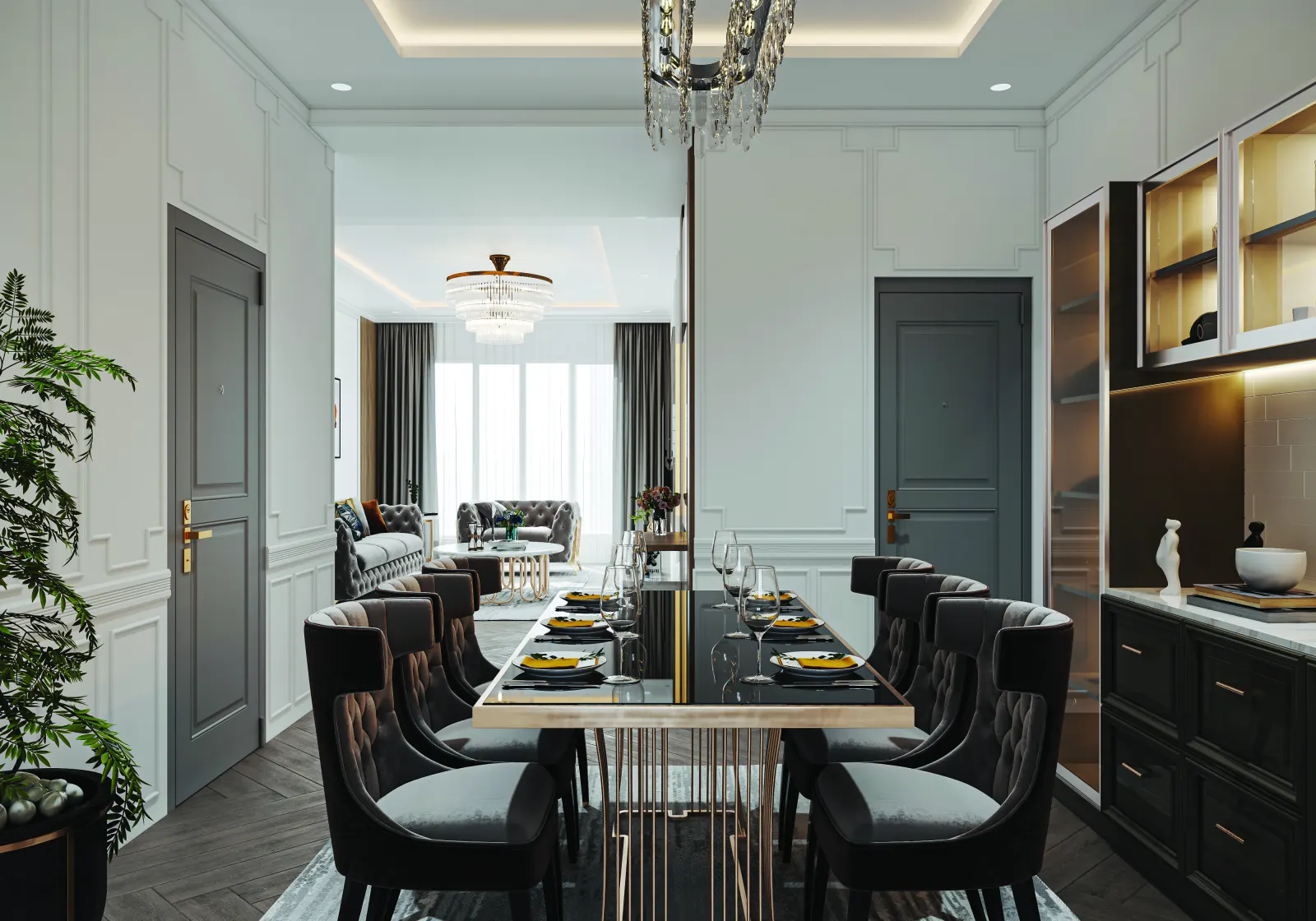
The crockery unit is the piece of furniture guests judge before they've finished walking into your dining room. It's what your dinnerware, wine glasses, collected ceramics and everyday tumblers actually live in — and it's where design most often goes wrong in Indian homes. Either it's a leftover 1990s glass cabinet inherited from the parents, or it's a hastily-chosen unit from a furniture showroom that doesn't quite fit the room's proportions.
This guide brings together 40 crockery unit designs our team actually builds for Bangalore homes, organised by how buyers naturally shortlist — by style, by layout and space, by material, and by special features. Every design carries a theme, a working 100–130 word brief, key specs (ideal home type, room size, materials, hardware, lighting, price), pros and cons at a glance, and a lifestyle tip explaining where the design actually works.
Price note: All prices are Huma Interiors factory-direct rates for July 2026, including material, hardware (Hettich/Ebco/Hafele), glass, finish, factory production, delivery within 30 km of Chandapura, and installation. Retail showroom prices for equivalent builds typically run 25–35% higher. Prices below are for a "standard 5 ft wide" unit unless otherwise noted.
Why the crockery unit actually matters
A well-designed crockery unit does four things a wardrobe or storage cabinet cannot. It displays what you're proud of — dinnerware sets from travels, inherited silverware, wedding crystal, ceramic pieces you've collected. Storage that stays hidden loses this emotional value. It defines the dining zone — in open-plan homes, the crockery unit is often the piece that visually marks where "dining" ends and "living" begins. It controls light in the room — glass-fronted units bounce light, solid units absorb it. And in Bangalore homes it plays a climate role — properly sealed units protect dinnerware from the 65–80% humidity swing that fogs glass and tarnishes silver over time.
Beyond aesthetics, apartment planning matters. Bangalore homes in Whitefield, Sarjapur Road, Electronic City and HSR Layout typically have dining rooms of 100–160 sqft in 3BHKs and 60–90 sqft in 2BHKs. The right crockery unit for a 3BHK master dining is very different from a compact 2BHK dining nook, and matching the design to the actual room size is where most homeowners get it wrong.
Quick price guide by unit type
Before the design sections, here is what different crockery unit types cost in Bangalore in 2026 — Huma factory-direct rates, fully installed. Use it to narrow your focus.
| Unit type | Best for | Price range |
|---|---|---|
| Compact wall-mounted (3 ft) | Studio, 1BHK, rental homes | ₹18,500 – ₹32,000 |
| Standard floor-standing (4–5 ft) | 2BHK dining rooms | ₹35,000 – ₹65,000 |
| Corner crockery unit | L-shaped dining rooms | ₹42,000 – ₹78,000 |
| Glass-fronted premium (5–6 ft) | 3BHK dining rooms | ₹58,000 – ₹95,000 |
| Veneer / solid wood carved | Traditional and premium homes | ₹75,000 – ₹1,45,000 |
| LED-integrated display unit | Modern master dining rooms | ₹85,000 – ₹1,50,000 |
| Full-height partition unit | Open-plan 3BHK / 4BHK | ₹95,000 – ₹1,80,000 |
| Bar-integrated crockery unit | Entertaining-focused homes | ₹1,25,000 – ₹2,20,000 |
Crockery unit designs by style (10 ideas)
Style is where most buyers start — the visual language of the unit has to match the rest of the dining and living room. These ten designs cover the aesthetic vocabularies our team quotes for most often in Bangalore homes, from restrained minimalism to full-bodied traditional teak.
Minimalist White Floating Crockery Unit
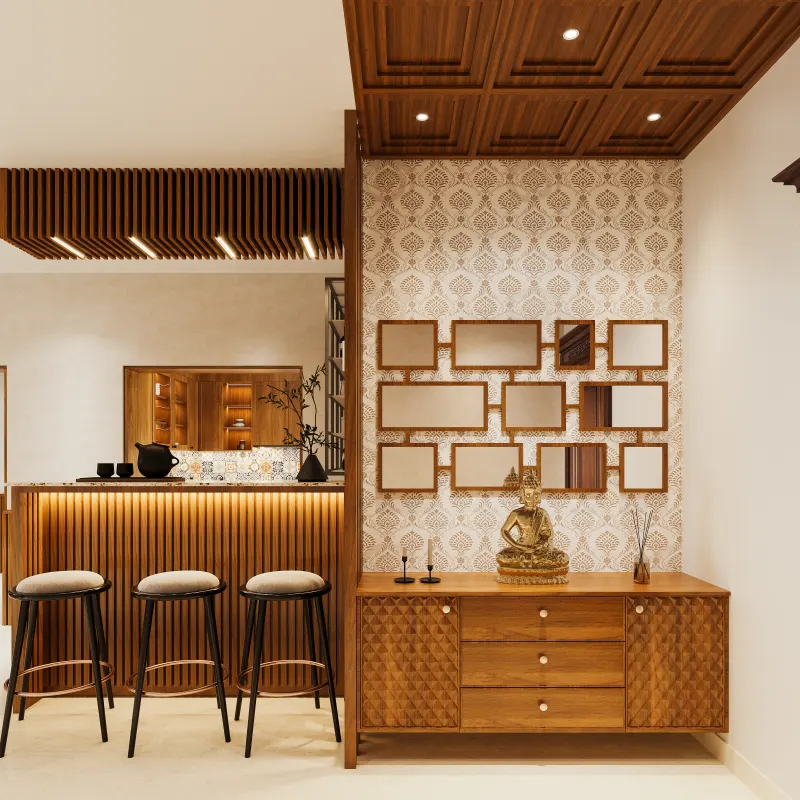
A slim 4-foot wall-mounted unit in warm white matte laminate, with handle-less push-open doors and a single continuous horizontal line. The design withdraws visually so that the dinnerware and any styling on top become the focus. Works especially well in compact dining rooms where a floor-standing unit would feel bulky. The floating design keeps the floor visually clear, which makes the room appear larger. Best paired with a light oak dining table and slim brass pendant.
Modern Fluted Wood Crockery Cabinet
A 5-foot tall unit with vertical fluted walnut MDF panels on the lower doors and drawers, and a fluted-glass upper display section. The fluting catches light through the day and adds movement without pattern. This is the most-quoted crockery design in Bangalore 2BHK and 3BHK dining rooms in 2026 — it looks premium, ages well, and photographs beautifully. Interior LED strip in the display section adds warmth in the evenings without harsh brightness.
Scandinavian Half-Height Display Unit
A 4-foot low sideboard with three drawers and two cabinet doors, topped by open floating shelves on the wall above. The lower unit holds bulk items behind closed doors, while the shelves display collected ceramics and glassware. Light birch or pale oak finish keeps the whole composition airy, ideal for compact dining spaces. The horizontal proportion visually widens the room without darkening it. A slim brass reading lamp above adds warmth for evening dining.
Japandi Ash-Wood Slim Crockery Cabinet
A 5-foot tall narrow-depth cabinet (14 inches deep) in ash wood with rice-paper style glass doors on the upper section and warm linen fabric behind the glass. The unit references Japanese tansu chests but keeps Scandinavian warmth. Ideal for homeowners who value quiet, considered design over statement pieces. Reduced depth makes it fit even in narrow dining spaces without dominating. The rice-paper glass diffuses the display gently — you sense the shape of dinnerware without seeing details clearly.
Industrial Metal-Frame Glass Cabinet
A 5-foot tall cabinet with a black powder-coated steel frame, clear glass panels on three sides, and toughened glass shelves. The exposed frame references warehouse and loft aesthetics. Best paired with a live-edge wood dining table, leather chairs and warm Edison-bulb pendants. The frame is welded rather than bolted for structural strength — visible bolt heads read cheap in this style. Not for homes with young children as the exposed edges are unforgiving.
Traditional Teak Carved Crockery Almirah
A 6-foot solid teak crockery almirah with hand-carved rosette panels on the base cabinets, bevelled glass on the upper display section, and antique brass handles and hinges. The design references South Indian heritage furniture — the kind that gets passed down generations. Solid teak construction with traditional mortise-tenon joinery ensures 30+ year lifespan. Suits homes with a strong traditional or Indo-modern aesthetic. Requires teak oil polish once every 18 months to maintain the finish.
Modern Classic Wainscoted Display Cabinet
A 5-foot tall cabinet with applied moulding panels on the lower doors, painted cream or sage green, with a clear glass display section above. The design references five-star hotel dining rooms — restrained, symmetrical, timeless. Flanked by brass wall sconces on either side, it becomes the visual anchor of the dining room. The moulding grid needs perfect finishing — sloppy moulding joins read cheap. Suits homeowners who plan to live in the home for 10+ years and want a design that won't date.
Suite-Grade Backlit Crockery
A 6-foot tall unit in smoked oak veneer with the entire back panel of the display section backlit with warm champagne-toned LED strips. The dinnerware and glassware appear to float in gentle ambient light. Designed for master dining rooms where the unit itself provides mood lighting. Requires professional electrical planning — driver, dimmer and tunable warm-cool LED are all standard. Pair with a marble-topped dining table and low-hanging brass pendant for a hotel-suite aesthetic.
Contemporary Two-Tone Crockery Unit
A 5-foot tall unit with deep navy blue lower cabinets and white oak upper display section, separated by a slim brass accent line. The two-tone treatment adds visual interest without pattern and keeps the room feeling contemporary. Popular in Bangalore 3BHKs where homeowners want personality without committing to a strong style. Also works in forest green + cream or terracotta + sand combinations. Match dining chair upholstery to the accent tone for cohesion.
Mid-Century Tapered-Leg Sideboard
A low 6-foot horizontal sideboard on angled tapered walnut legs, with sliding fluted glass panels revealing a display and drawer section. The design references classic 1960s Scandinavian furniture — restrained, warm, quietly confident. Best paired with mustard or teal upholstered dining chairs and a single sculptural pendant lamp. The proportions read as adult and considered, and the low profile keeps the dining room visually open. Signature piece for style-forward homeowners.
Not sure which style suits your dining room?
Share your dining room photos and rough dimensions. Our design team will suggest 2–3 matching crockery unit designs with material and price breakdowns — free, no obligation.
Crockery unit designs by layout & space (10 ideas)
Bangalore homes come in every layout — 1BHK studios in Koramangala, 2BHK compact apartments in Whitefield, sprawling 3BHKs in Sarjapur, open-plan villas in Electronic City. The layout dictates what actually fits and works. These ten designs solve for specific spatial constraints rather than aesthetic preferences.
Wall-Mounted Floating Crockery Cabinet
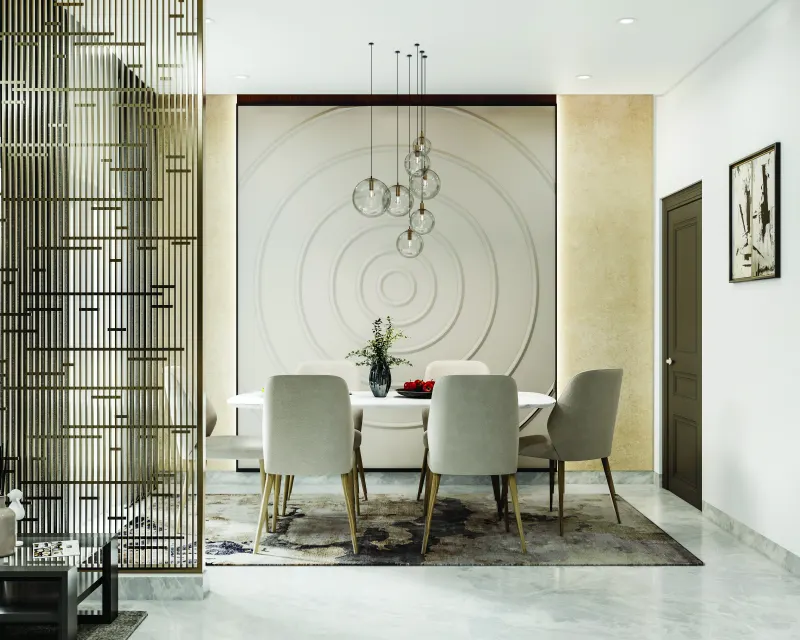
A 3-foot wide wall-mounted unit at eye level, freeing the entire floor below for a console table or seating. Ideal for studio apartments and compact 1BHKs where a floor-standing unit would eat critical floor space. The mounting requires structural anchoring into wall studs or a plywood ledger — a common failure point when cheaply installed. Depth kept to 12 inches to prevent room from feeling cramped. Add a slim brass wall sconce below for warm ambient lighting.
Corner Crockery Unit with Curved Glass
A 5-foot tall corner unit fitting into a 90° dining room corner, with a curved bent-glass front that softens the geometry and gives a wider display view. The design uses what would otherwise be dead corner space. Best for L-shaped dining rooms and diagonal room layouts where a straight wall unit doesn't fit. Curved glass is 30% more expensive than flat glass and requires specialist installation, but the result is worth the premium in the right room.
Full-Height Floor-to-Ceiling Crockery
A 7–8 foot tall unit spanning floor to ceiling and 6–7 feet wide, with mixed closed storage, glass display and open shelf zones. The scale reads as built-in architecture rather than furniture, which visually organises the dining wall completely. Upper shelves are hard to reach — best for display-only, not daily-use items. Requires ceiling-height planning during the build; not easy to retrofit later. Massive storage capacity: holds dinnerware for 20+ people plus display collection.
Partition Crockery Unit (Room Divider)
A full-height double-sided unit dividing the dining room from the living room, with glass-fronted crockery display on the dining side and closed storage or open shelving on the living side. The unit provides visual separation without walling off the space, keeping the open-plan feel while giving both rooms a functional identity. Requires floor anchoring, ceiling bracing and a rigid central spine. Structural planning is more complex than any standalone unit.
L-Shape Corner Crockery
Two connected units meeting at a corner in L-configuration — the main arm 5 feet wide and the return arm 3 feet. The 90° meeting point uses a curved return so the eye reads continuous rather than broken. The design provides significantly more storage than a single-wall unit while using the natural room geometry. Best in dining rooms where two adjacent walls are both viable placement — common in 3BHK layouts where the dining sits in a corner between kitchen and living.
Slim Console Crockery Unit
A 4-foot long unit only 12 inches deep, low profile at 3 feet tall. Works as a console table when the room can't accommodate a standard 20-inch deep unit. Storage capacity is lower but the design fits in narrow passages between kitchen and dining. Doors are usually push-open handle-less for a cleaner front. Best in compact 2BHK apartments where the dining is a transition space rather than a separate room. Pairs well with a mirror above.
Under-Staircase Crockery Cabinet
Custom-built into the void under a rising staircase, this unit turns dead space into functional storage and display. The stepped top mirrors the staircase geometry above, and closed doors house bulk storage while glass panels display collected pieces at eye-height. Common in duplex villas and independent homes with internal staircases. Requires site-specific measurement — no two staircases produce the same void dimensions, so this is always a custom quote.
Bay-Window Crockery Bench
A bench-style crockery unit fitting under a bay window, with lift-top or drawer storage below the seat cushion, and glass display shelves floating on the wall above the window. The design turns a window feature into a functional storage-and-seating combo. Ideal for villas and premium 3BHKs with bay windows in the dining room. The bench doubles as extra seating for large gatherings. Requires custom sizing based on window dimensions.
Kitchen-Extension Crockery Cabinet
A crockery unit designed as an extension of the kitchen, using matching finish, hardware and proportions so the dining-kitchen boundary reads continuous. This is particularly valuable in open-plan 3BHKs where the kitchen and dining share visible sight lines. The unit typically sits against the wall shared with the kitchen and echoes the kitchen's material palette. Requires kitchen and crockery unit to be manufactured together for exact finish match.
Bar-Integrated Crockery Unit
A 6-foot tall combined unit with the left half dedicated to crockery display and storage, and the right half configured as a home bar — wine rack, bottle display, hanging stemware rack, mirrored back panel and integrated glass rinser. The design condenses two furniture pieces into one and works well for homeowners who entertain regularly. Requires plumbing for the glass rinser if included. LED strip lighting inside the bar section adds evening ambience.
Have an unusual dining layout?
Corner, under-stair, partition or bay-window setup — we build custom crockery units for every layout. Send us your dining room photos and we'll suggest what fits.
Crockery unit designs by material & finish (10 ideas)
Material choice affects durability, look and cost more than any other decision. Solid wood ages beautifully but costs 2–3x more than veneer. Glass adds display value but needs weekly cleaning. PU lacquer looks premium but scratches show. These ten designs are organised by primary material so you can shortlist by what the unit is actually made of.
Glass-Fronted Aluminum Frame Crockery
A 5-foot tall unit built around an anodised aluminium frame with clear glass panels on three sides and toughened glass shelves inside. The metal frame is much slimmer than a wooden equivalent (25 mm sections vs 45 mm), giving the unit a light visual footprint. Available in silver, black or brushed brass frame finishes. The 360° visibility maximises display but means every side needs to be styling-worthy — no place to hide clutter.
Solid Wood Rosewood Crockery Cabinet
Genuine solid rosewood construction with traditional mortise-tenon joinery, hand-detailed edging on drawer fronts and bevelled glass on the upper display section. Rosewood is prized for its rich reddish-brown tone that deepens over decades. Not a piece for a rental — this is a lifetime investment that gets passed to the next generation. The joinery matters more than the surface finish; well-jointed rosewood outlasts three generations. Bangalore's climate is generally kind to rosewood.
High-Gloss PU Lacquer Crockery Unit
A 5-foot tall unit with a mirror-smooth PU lacquer finish in warm champagne, deep navy, forest green or classic ivory. PU (polyurethane) lacquer produces a glass-like surface far superior to standard laminate — it feels premium to the touch and reflects light beautifully. Requires perfect substrate — any waviness in the plywood telegraphs through the mirror finish. Higher maintenance than laminate: shows fingerprints and dust more clearly, needs weekly wipe-down.
Acrylic Handle-less Modern Crockery
A 5-foot tall unit with high-gloss acrylic (or matte acrylic) doors and push-to-open mechanism throughout — no visible hardware. Acrylic sheets are laminated onto BWP ply substrate at the factory and edge-banded to prevent moisture ingress. The finish is more scratch-resistant than PU lacquer and has slightly warmer light reflection. Ideal for contemporary and modern minimalist homes. Available in solid colours (ivory, warm white, grey) and metallic tones (champagne, brushed steel).
Marble-Top Veneer Body Crockery
A 5-foot floor-standing unit with a solid Statuario or Calacatta marble top on a walnut veneer body. The stone top serves as a serving surface during dinner parties and adds architectural weight. Requires structural planning — marble tops add 40–60 kg to the unit and need reinforced sub-frame. Best paired with a live-edge or slab dining table and modern brass pendants. The marble needs sealing every 2 years to prevent staining from wine and oil.
Cane-Insert Panel Crockery
A 5-foot unit with solid wood frame and natural cane weave inserts on the lower cabinet doors, with clear glass on the upper display section. The cane adds textural warmth and lets a hint of the interior show through, softening the visual weight of the unit. Common in bohemian, coastal and Japandi-styled homes. Bangalore's humidity is fine for cane, but the panels need 2 mm expansion gaps and shouldn't be installed right after monsoon when they're at maximum expansion.
Fluted Glass Door Crockery Cabinet
A 5-foot tall unit with reeded or fluted glass panels on the display doors, softly obscuring the contents while still letting shape and colour show through. The ribbed glass texture catches light beautifully and adds visual interest without pattern. Ideal for homeowners who want the display effect but don't want every item on the shelf to be perfectly arranged. The frosted-textured quality means fingerprints show less than on clear glass — practical benefit for daily-use homes.
Matte Laminate Modular Crockery
A 5-foot modular unit in matte laminate finish — warm grey, soft cream, or muted olive — on BWP plywood substrate. The best-value design in this guide: 80% of the visual effect of premium PU-finish units at 55% of the cost. Matte laminate hides fingerprints and daily wear far better than gloss. Available across a wide colour palette. Best for young families, budget-conscious homeowners, or anyone building their first home who doesn't want to over-commit financially.
Metal Mesh Front Crockery Cabinet
A 5-foot tall cabinet with woven metal mesh (black powder-coated steel or brushed brass) inserts on the door panels, framed in solid oak or walnut. The mesh partially reveals the interior — you see silhouettes of the dinnerware and glassware without full display exposure. A distinctive alternative to standard glass doors. Best paired with an industrial or modern-classic dining setup. The mesh doesn't collect dust as much as expected — the open weave lets air flow.
Two-Tone Veneer + Lacquer Combo
A 5-foot unit combining walnut veneer on the display glass surround and cabinet frame with a contrasting deep-tone PU lacquer (navy, forest green or charcoal) on the lower doors. The material contrast reads intentional and considered — the two finishes work harder together than either would alone. The upper display section becomes the visual anchor while the lacquered lower doors ground the composition. Requires factory finishing precision to align the material break line cleanly.
Crockery unit designs with special features (10 ideas)
Some crockery units earn their price through a single distinguishing feature — LED lighting, integrated wine storage, hidden bar, rotating carousels, or charging stations. These ten designs focus on what specific functional feature makes the unit worth its cost.
LED Backlit Glass Display Crockery
A 5-foot tall unit with the entire back wall of the display section backlit with tunable warm-cool LED strips, controlled by a dimmer at the side. The dinnerware appears to float in gentle light — cool white during day for utility, warm amber for evening dining. Requires a driver-and-dimmer setup that can be professionally installed and serviced. The most requested premium feature in Bangalore dining rooms as of 2026 — the display looks like a jewelry store showcase.
Integrated Wine Rack Crockery Cabinet
A 5-foot tall unit with the left third dedicated to a diagonal wine rack (24 bottles), the middle section for stemware display with hanging glass rack underneath, and the right third for standard crockery display and storage. The wine rack section is positioned at the correct 15° angle to keep corks moist. Ideal for wine enthusiasts who want their collection displayed and accessible without a dedicated wine cabinet. Add a temperature-controlled section for an extra ₹25,000.
Hidden Bar Behind Crockery Doors
A 5-foot unit that reads as a standard crockery cabinet — solid door fronts with tasteful glass display upper — but a section of the interior conceals a fully-fitted home bar. Push-open reveals a mirrored back panel, bottle display, glass holders and integrated LED lighting. The design lets homeowners maintain a subdued daytime aesthetic while entertaining in the evenings. Especially valued in homes with young children, where an open bar wouldn't be appropriate.
Pull-Out Drawer Crockery Unit
A 5-foot unit configured with 6–8 deep pull-out drawers instead of standard cabinet doors, each with customised dividers for specific items — cutlery in one, plates stacked vertically in another, glassware in padded slots. Drawers with full-extension channels give 100% visibility of contents without bending or reaching. Much more ergonomic than cabinet-style storage for daily use. Best for homeowners who cook and entertain frequently and value quick access.
Rotating Carousel Crockery Cabinet
A specialised 5-foot unit with rotating carousel shelves in the lower section — pull open the door and the entire shelf rotates on a bearing to bring back-of-shelf items to the front. Ideal for compact dining rooms where deep shelves would make items hard to reach. Carousel mechanisms from Hettich come with 15-year warranties. Higher cost than standard shelves but the ergonomic value is substantial for elderly homeowners or people with mobility considerations.
Mirror-Backed Display Crockery
A 5-foot tall unit with an antique-finish mirror back panel throughout the display section. The mirror visually doubles the dinnerware and glassware and adds depth to the display. Especially effective for crystal, cut glass and metallic pieces which catch reflected light beautifully. Antique-finish mirror reads more sophisticated than clear silver for this application. Requires careful lighting — direct LED strip on the glass shelves reflects off the mirror to create sparkling accents.
Charging Station Crockery Cabinet
A 5-foot unit with a recessed charging niche at counter height — includes 2 USB-A ports, 1 USB-C port, and a wireless charging pad on a small marble insert. The niche also serves as a device docking station during meals so phones aren't on the dining table. Especially valued in family homes with teenagers. The electrical integration requires factory-side planning and a dedicated 5V power supply. Adds ₹10,000–₹15,000 over a standard equivalent unit.
Push-to-Open Concealed Crockery
A 5-foot tall unit with a completely flush handle-less facade — no visible hardware, no gaps, no seams beyond hair-thin door edges. Push-to-open mechanism throughout (Blum or Hettich). Reads more like architecture than furniture. The clean facade means all the visual attention goes to the material and finish rather than any decoration. Best in ultra-modern homes where restraint is the design language. Push-open needs periodic realignment every 3–4 years.
Combined Crockery + Buffet Sideboard
A 6-foot horizontal unit combining a crockery cabinet (upper display + closed lower storage) with an extended flat serving surface at counter height. The top surface serves as a buffet during dinner parties — hot food, salad bowls, dessert setup all fit comfortably. When not in use, it holds a fruit bowl and a small vase. The design condenses two furniture needs — crockery storage and serving surface — into one piece. Especially useful for families who host often.
Bar Counter + Crockery Combo
A 7-foot wide combined unit with a full crockery display and storage section on one side and a bar counter with two bar stools on the other. Includes a mirrored back panel with bottle display, hanging stemware rack, integrated LED lighting, mini fridge compartment, and glass rinser (optional plumbing). The most complete entertaining piece in this guide. Requires 8+ feet of clear wall space and plumbing planning if the rinser is included. Signature piece for social households.
Want a specific feature combined?
Backlit display with hidden bar and charging station in one unit — possible. Send us your feature wishlist and we'll quote the combined build.
Materials guide — what to pick and why
Material choice determines how the unit ages, how it handles Bangalore humidity, and how much of your budget goes to structure versus finish. Here is a working comparison of the substrates and finishes we use.
| Material | Lifespan | Best for | Cost impact |
|---|---|---|---|
| BWP-grade plywood substrate | 15–20 years | All finish types, humid climate | Baseline |
| Solid wood (teak, rosewood) | 30+ years | Traditional and heritage designs | +150–220% |
| Veneer on BWP ply | 15–20 years | Premium modern designs | +30% |
| PU lacquer finish | 10–15 years | Glossy statement pieces | +40% |
| Acrylic laminate | 12–15 years | Modern handle-less designs | +20% |
| Standard laminate | 10–12 years | Budget-conscious builds | -15% |
| Toughened glass (6–8mm) | Lifetime (barring impact) | Display sections | +15% per glass zone |
| Marble slab top | Lifetime | Serving surface, statement piece | +35% per marble section |
Why BWP plywood matters in Bangalore
Bangalore's 55–82% humidity swing means MR-grade plywood swells and warps within 3–4 years, especially in monsoon months. BWP (Boiling Water Proof) grade uses phenol formaldehyde adhesive that resists water and humidity indefinitely. The cost difference is under 8%. Every Huma Interiors crockery unit uses BWP substrate as standard. If a competitor quote doesn't specify the plywood grade, ask — it's the single most common corner-cutting practice in this industry.
Greenply and Century — the industry benchmarks
We use only Greenply Ecotec or Century Sainik BWP-grade plywood as substrate. Both are ISI 710 certified for boiling water proof performance. Cheap alternatives use "commercial BWP" which technically meets the standard but has weaker glue lines. The premium is around ₹80/sqft over the cheapest BWP — for a standard crockery unit, that's a total ₹2,500 difference and it prevents ₹40,000+ replacement cost 5 years later.
Hardware — Hettich, Ebco, Hafele
The hardware choice matters as much as the substrate. Cheap Chinese hinges rust in Bangalore humidity within 2 years. Hettich, Ebco and Hafele all carry lifetime warranties on soft-close hinges and 10-year warranties on drawer channels. Our default: Hettich soft-close hinges for doors, Ebco full-extension channels for drawers, Blum push-open for handle-less designs. All included in Huma quotes — never optional add-ons.
Storage planning — what actually fits
A well-designed crockery unit is planned around what you actually own, not around abstract "storage capacity." Here is a working reference for what fits in different unit sizes.
| Unit size | Dinnerware | Glassware | Cutlery | Display pieces |
|---|---|---|---|---|
| Wall-mounted (3 ft) | Set for 4–6 | 6–8 glasses | Cutlery for 6 | 3–5 pieces |
| Slim console (4 ft) | Set for 6–8 | 10–12 glasses | Cutlery for 8 | 4–6 pieces |
| Standard 5 ft | Sets for 8–12 | 12–18 glasses | Cutlery for 12 | 8–12 pieces |
| L-shape / Corner | Sets for 12–16 | 18–24 glasses | Cutlery for 16 | 12–18 pieces |
| Full-height 6 ft | Sets for 12–16 + 1 heirloom set | 24 glasses + stemware | Cutlery for 16 + serving | 15–20 pieces |
| Partition unit 7 ft | Sets for 20+ across both sides | 30+ glasses + full stemware | Multiple cutlery sets | 20–25 pieces |
Storage tips from our design team
- Plates stack better vertically than horizontally. Plate racks that hold plates on edge save 40% vertical space compared to stacks.
- Cutlery divider inserts save the drawer. A ₹2,000 velvet-lined cutlery divider prevents scratching of silverware and doubles as visual organisation.
- Hang stemware upside-down. Hanging stemware racks use the ceiling space of the shelf, freeing shelf area for other items and preventing dust rings on glass rims.
- Reserve the top shelf for display, not storage. Anything above shoulder height gets used once a year at most. Use those shelves for the pieces you want to see.
- Deep shelves waste space without dividers. Anything deeper than 14 inches needs pull-out mechanism or vertical dividers to actually be usable.
Buying guide — how to choose the right crockery unit
Forty designs is a lot. This five-step decision path removes most of the options in five minutes.
- Measure the wall. Standard placement is against the longest clear wall in the dining room. Measure the wall width and height. Under 4 ft of wall → wall-mounted or slim console (#11, 16). 4–6 ft → standard floor-standing (#1–10). Over 6 ft → full-height or bar-integrated designs (#13, 20, 40).
- Set a budget. ₹30,000 buys a compact wall-mounted or matte laminate unit. ₹65,000 buys standard veneer or fluted MDF designs. ₹1 lakh buys premium veneer, glass-fronted or LED-integrated. ₹1.5 lakh+ buys full-height partition, solid wood, or bar-integrated.
- Decide storage vs display balance. Have display-worthy dinnerware? Choose glass-fronted (#5, 21, 27, 36). Everyday dinnerware you want hidden? Choose solid-door designs (#1, 3, 28, 34). Mixed use? Two-tone with upper glass and lower solid (#2, 9, 30).
- Match the room style. If your dining chairs are traditional or classical → traditional teak or wainscoted (#6, 7). Modern or contemporary → fluted MDF, glass frame or two-tone (#2, 21, 9). Minimalist → floating handle-less or slim console (#1, 16, 24). Style-forward → mid-century or industrial (#5, 10, 29).
- Consider your lifestyle. Entertain often? Bar-integrated or buffet combo (#20, 39, 40). Wine collection? Wine-rack integrated (#32). Elderly household? Rotating carousel (#35). Tech-heavy family? Charging station (#37).
Expert tips from the Huma Interiors design team
Practical lessons from 100+ completed Bangalore projects — the details that separate a well-designed crockery unit from an average one.
Crockery unit width should be equal to or one foot wider than the dining table length. A 6-ft dining table with a 4-ft crockery unit looks visually off-balance. Measure the dining table before the wall — the composition ratio matters more than filling the wall.
Homeowners underestimate how visually "loud" glass shelves are. Ten items on a glass shelf look busy; ten items on a wooden shelf look considered. Plan for 30% fewer items on glass shelves than you initially estimate.
Warm 2700K LED lighting makes wooden veneer, brass and warm-tone dinnerware look richer. Cool 4000K LED lighting flattens colours and reads clinical. For evening dining ambience, always specify 2700K. Tunable 2700–4000K adds ₹4,000 but gives day/night flexibility.
LED integration, charging stations, and interior sensors all need power planning at the design stage. Retrofitting electrical after the unit is installed almost always shows compromise — visible wires, awkward driver boxes, mismatched socket colours.
If the dining room and bedroom share a sight line, match the crockery unit finish to the wardrobe finish. This makes the home feel considered rather than assembled. In Bangalore 3BHKs where the bedroom door often opens toward the dining, this small choice makes a real difference.
Common mistakes to avoid
Seven mistakes we see most often in Bangalore crockery unit projects — the ones that cost time, money or design regret.
Buying a fixed-size unit for a custom space
Ready-made showroom units are sized for average rooms, not your specific dining wall. Gaps at edges, height mismatch with adjacent furniture, and depth issues are inevitable.
Choosing MR plywood instead of BWP
The 8% cost saving on substrate leads to warping within 3–4 years in Bangalore's humidity. Once warped, doors don't close properly and the finish shows waves.
Cheap hardware that rusts in monsoon
Non-branded Chinese hinges and drawer channels rust within 2 years in Bangalore. Once rusted, doors sag and drawers don't slide properly.
Making the unit too tall for the ceiling
A 7-foot unit in a room with 9-foot ceiling leaves a 2-foot dust-collecting gap on top that always looks unfinished.
Skipping interior LED lighting
Without interior lighting, glass-fronted units look flat and dark in the evening. The display effect only works with light.
Placing crockery unit in direct sunlight
Bangalore's afternoon sun fades veneer and laminate, and heats glass shelves enough to weaken dinnerware over time.
Buying without measuring dinnerware first
Homeowners realise after installation that their large dinner plates don't fit shelf spacing or their tall stemware won't stand up.
Vastu & placement considerations
Vastu shastra is a factor for many Bangalore homeowners, particularly in dining room decisions. Here are the vastu principles that intersect with crockery unit placement, drawn from what our design team has heard from clients.
The ideal placement is against the west or south wall of the dining room, with the doors opening toward the north or east. This orientation is considered vastu-favourable for wealth and prosperity, which the crockery unit symbolises through valuable display pieces.
Avoid placing the crockery unit against the north wall or directly facing the main entrance — traditionally considered to invite loss rather than accumulation. Similarly, avoid placing the unit in the south-west corner (typically reserved for heavier furniture like sideboards or wardrobes).
Glass-fronted units are considered vastu-neutral to positive because they are visually light and non-obstructive. Solid dark units are considered heavier from a vastu perspective and better positioned in the south-west quadrant. Silver, brass, warm wood and clear glass finishes are traditionally preferred over stark black surfaces for the primary crockery unit.
Keep the display shelves clean and organised — vastu regards cluttered or dirty display shelves as attracting negative energy. A weekly wipe-down and quarterly deep clean of the display section is more important than the specific dinnerware displayed.
Mirror-backed displays are considered auspicious when they reflect and multiply the display items — traditionally symbolic of multiplied prosperity. However, avoid mirror placements that reflect the main entrance directly.
Care & maintenance
Different materials need different care rhythms. Here are the maintenance patterns for each major material.
- BWP plywood + laminate/veneer: Soft-brush dust weekly, wipe with barely-damp microfibre cloth monthly. Avoid all-purpose sprays. If PU-coated veneer, apply light wax polish annually.
- Solid wood (teak, rosewood): Vacuum dust weekly. Apply teak oil or natural wood polish once every 18 months. Avoid silicone-based sprays which build up.
- Glass shelves and doors: Clean with vinegar-water solution or dedicated glass cleaner weekly. Spray on cloth, not directly on glass — direct spray gets into hinge mechanisms.
- PU lacquer: Wipe fingerprints and dust weekly with damp microfibre. Avoid abrasive cleaners which scratch the surface.
- Acrylic laminate: Wipe with damp microfibre monthly. Special acrylic cleaner for stubborn marks. Avoid alcohol-based cleaners.
- Marble tops: Wipe with pH-neutral cleaner weekly. Reseal every 2 years to prevent staining from wine, oil and citrus.
- LED integration: Wipe strip covers gently quarterly. Have an electrician check drivers every 3 years — most LED "failures" are actually driver failures.
- Hardware (hinges, channels): Apply 3-in-1 oil to hinges annually. Vacuum drawer channels to remove dust every 6 months.
Style comparison — at a glance
A quick reference table comparing the four major style categories to help you decide which fits your home best.
| Category | Best for | Aesthetic | Typical price |
|---|---|---|---|
| Style-first (Designs 1–10) | Homes with a defined interior style | Style-consistent, personality-driven | ₹42,000 – ₹1,45,000 |
| Layout-first (Designs 11–20) | Unusual room shapes, compact homes | Function follows form | ₹28,000 – ₹1,68,000 |
| Material-first (Designs 21–30) | Design-forward homeowners | Material tells the story | ₹48,000 – ₹1,55,000 |
| Feature-first (Designs 31–40) | Homes with specific functional needs | Utility as design | ₹72,000 – ₹2,20,000 |
Why choose Huma Interiors for your crockery unit
Custom crockery units from Huma Interiors are factory-manufactured at our 5,000 sq ft Chandapura facility using materials and hardware we specify — not chosen based on the lowest quote for the day. Every unit uses BWP-grade plywood from Greenply or Century, hardware from Hettich, Ebco or Hafele, and PU or acrylic finish where applicable. Our design team includes senior interior designers who have completed 100+ Bangalore projects and understand exactly what works in local homes.
- Warranty up to 10 Years covering structural integrity, hinges, channels, LED functionality
- 30 Working Day Delivery from design confirmation to installation
- Factory-Direct Pricing — 25–35% below equivalent retail showrooms
- Dedicated Designer assigned to your project from consultation to handover
- Premium Materials as Standard — Greenply, Century, Hettich, Ebco included in every quote
- Free Design Consultation including 3D visualisation before you commit
- End-to-End Solutions — we handle measurement, design, factory production, delivery and installation
- Transparent Pricing — itemised quotes with material, hardware and finish costs shown separately
Frequently asked questions
What is the cost of a crockery unit in Bangalore?
Crockery unit costs in Bangalore start at ₹18,500 for a compact wall-mounted design and go up to ₹2,20,000+ for a full-height partition unit with LED lighting and integrated bar. Standard 4-foot floor-standing units range from ₹35,000 to ₹60,000. Premium veneer or glass-fronted designs sit at ₹70,000–₹1,20,000. Factory-direct pricing keeps Huma Interiors quotes 25–35% below retail showrooms.
What is the best material for a crockery unit?
BWP-grade plywood with laminate, veneer or PU finish is the most balanced choice for Bangalore homes — it handles humidity, holds hardware well and lasts 15–20 years. Solid wood suits traditional and heritage styles at 2–3x the cost. MDF with laminate is fine for wall-mounted lighter-duty units. Avoid particle board for anything holding weight of dinnerware or glassware.
Where should a crockery unit be placed in the house?
The dining room is the standard placement — either against the wall behind the dining table, adjacent to it, or as a partition between dining and living areas. In compact 2BHK homes, the kitchen-dining transition wall is a smart location. Corner placement suits L-shaped dining spaces. Avoid placing crockery units in direct sunlight (fades finishes) or near cooking zones (grease buildup).
What is the ideal size of a crockery unit?
A standard floor-standing crockery unit is 4–6 feet wide, 18–22 inches deep and 6–7 feet tall. Wall-mounted units are typically 3–4 feet wide, 12–15 inches deep and 3–4 feet tall. Full-height partition units run 6–8 feet wide and reach ceiling height. Compact homes work with 3-foot slim console units at 12-inch depth. Match the width to your dining table length within one foot on either side.
Should crockery units have glass or wooden doors?
Glass doors work best when you have display-worthy dinnerware, wine glasses or collected pieces — they make the unit visually lighter and add depth to the room. Wooden or laminate doors work when you want to hide everyday items (mixed dinnerware sets, plastic containers) and keep the room visually calmer. A common middle-ground: upper section with glass doors for display, lower section with solid doors for bulk storage.
How long does it take to build a custom crockery unit?
A factory-made custom crockery unit from Huma Interiors takes 20–30 days from design confirmation to installation. Wall-mounted and standard floor-standing units ship in 20 days. Full-height partition and LED-integrated designs take 25–30 days including glass, hardware and lighting integration. Timelines include measurement, 3D visualisation, factory production, finishing and site installation.
Do crockery units come with a warranty?
Huma Interiors covers all custom crockery units under a warranty of up to 10 years (5 years as standard). The warranty covers structural integrity, hinges, drawer channels, LED functionality and hardware from Ebco, Hettich and Hafele. Surface wear from daily use, glass breakage from impact, and modifications after installation are not covered. Toughened glass on display doors comes with a 2-year manufacturer warranty.
Can a crockery unit be used as a partition between dining and living rooms?
Yes — partition crockery units are one of our most-quoted designs for open-plan 3BHKs. Full-height double-sided units with glass on the dining side and closed storage on the living side serve both as room divider and functional storage. Structural planning matters: the unit needs floor anchoring, ceiling bracing and a rigid backbone. Expect ₹85,000–₹1,80,000 depending on width, materials and glass type.
What is the vastu direction for a crockery unit?
Vastu shastra recommends placing crockery units along the west or south walls of the dining room, with the doors opening toward north or east. Avoid placing crockery units directly against the north wall or facing the main entrance. Glass-fronted units work well vastu-wise because they are considered light and non-obstructive. Silver, brass or clear glass finishes are preferred over dark black surfaces.
How much storage does a standard crockery unit hold?
A standard 5-foot wide crockery unit typically stores dinnerware for 8–12 people (2 sets), 6–8 serving bowls, 12–18 wine glasses, 8–10 water tumblers, cutlery for 12, a tea set, and one or two decorative display objects. Full-height partition units accommodate 2–3x this capacity plus a wine rack or bar. Wall-mounted units hold display pieces and glassware for 4–6 people.
Ready to design your crockery unit?
Every design in this guide is available as a factory-direct custom build. Our design team will visit your home for on-site measurement, prepare 3D visualisation matched to your dining room's existing furniture and lighting, and quote a firm price within 48 hours. All work is backed by Huma Interiors' warranty of up to 10 years. There is no obligation after the quote, and the design consultation itself is free.
The three most-quoted crockery units among 2026 Bangalore projects have been the modern fluted wood cabinet (#2), the fluted glass door design (#27), and the LED backlit display unit (#31). Between them, they cover the majority of modern dining preferences at three different price points.