Small Pooja Room Design Ideas for Bangalore Apartments
Seven practical layouts, Vastu-vs-real-life logic, smoke and safety planning, warm lighting design and honest 2026 pricing — from a Chandapura factory-direct design team.
7 design ideas by apartment layout
Vastu rules that actually apply
Safety + smoke management covered
30 working days · warranty up to 10 years
100+
Homes Delivered
20 YR
Industry Experience
5000
Sqft Own Factory
30
Working Days
10 YR
Warranty (up to)
Almost no builder-standard Bangalore apartment gives you a dedicated pooja room. What you get instead is a bare wall, a corner, or at best a small builder-provided niche in the foyer or dining area. Turning that into a functional daily-use pooja space — one that respects Vastu where practical, handles incense smoke, keeps a diya safe, and stores everything a pooja actually needs — takes real design thinking, not a Pinterest board. This page covers seven small pooja room designs in apartments across Bangalore, along with the Vastu logic, safety rules, lighting design and honest 2026 pricing that most guides skip.
We are Huma Interiors, a factory-direct design and manufacturing team based in Chandapura, at the southern edge of Bangalore. Our 5,000 sqft factory produces custom pooja units alongside kitchens, wardrobes and full-home interiors. Every idea, every material specification and every safety rule in this article comes from apartments we have actually designed for — not from a generic mandir catalogue.
1. Where to Place a Pooja Unit in a Small Bangalore Apartment
Before the design ideas, pick the location. A 1,200 sqft Bangalore 2BHK has maybe five practical spots for a pooja unit. Each has trade-offs. Choose based on apartment layout and daily traffic patterns, not just Vastu.
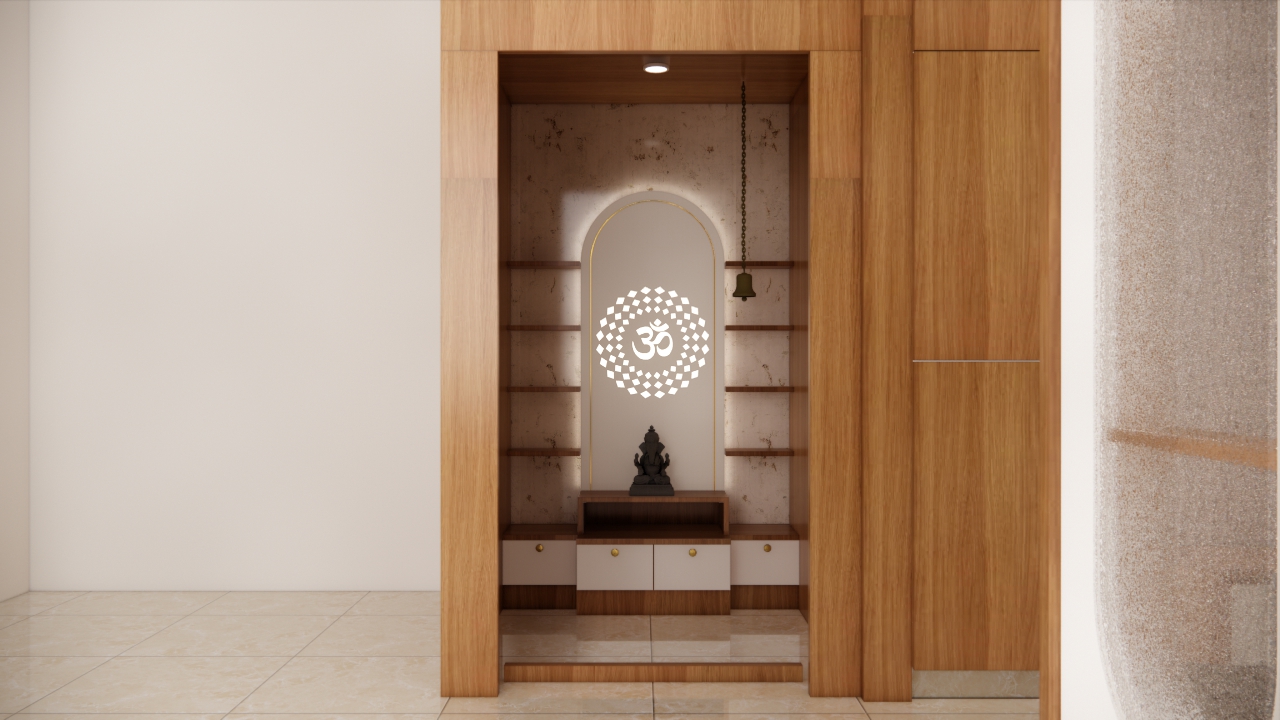
Pooja unit with a backlit panel
Location
Best For
Advantages
Watch Outs
Common In
Foyer / Entrance Wall
1BHK, compact 2BHK
Visible on arrival, does not intrude
Direct main door wind blows out diya
Small apartments across Sarjapur / HSR
Living Room Wall
2BHK, 3BHK
Central to family gatherings
Guest visibility during aarti
Prestige / Brigade 2/3BHKs
Dining Wall
Open-plan 3BHK
Adjacent to kitchen; useful for prasad flow
Cooking oil vapours can reach the unit
Sobha / Godrej 3BHK opens
Bedroom Niche
Elderly parents' bedroom
Private, quiet, always accessible
Smoke and camphor in sleeping area
3BHK premium apartments
Builder-Provided Niche
Any apartment with one
Pre-planned electrical + framing
Standard size rarely fits your idols
Newer Prestige, Brigade, Sobha builds
Expert InsightThe foyer wall works best in compact 2BHK apartments because it keeps the pooja visible on entry (traditional welcome ritual) without occupying scarce living-room wall space. In 3BHKs, we more often recommend the dining wall — the pooja stays close to where the family gathers, and prasad flow to the kitchen becomes natural. Living room walls are our third choice, useful when the other two are structurally blocked.
Contractor TipBefore finalising location, walk through the apartment during your usual pooja time (typically 6–8 am and 6–8 pm) and check the natural light and airflow. A location that looks perfect on the 3D render might be directly under an AC vent or in the path of the main door draft. Two minutes of physical simulation reveals fit issues no drawing catches.
Common Customer MistakePlacing the pooja unit on a wall shared with a toilet or immediately adjacent to the kitchen hob. Both are considered Vastu inauspicious for genuine reasons — plumbing dampness weakens the shared wall over time, and hob heat carries oil vapour and grease onto the pooja finishes. If the only available wall is a shared wall, add a 4-inch furring layer between the wall and the pooja unit.
2. Vastu Rules That Actually Matter in Apartment Constraints
In most Bangalore apartments, strict Vastu compliance is impossible. The ideal northeast (Ishaan) corner is usually the master bathroom or the second bedroom. You will make trade-offs. The question is: which Vastu rules genuinely matter and which are negotiable?
Vastu Rules Worth Following
Face east or north while praying (this is more important than the room's corner direction)
Idols should not directly face the main door
Do not place the pooja unit under a beam
Idols facing each other is inauspicious — arrange in a single plane
Do not place directly against a toilet wall (also practical: dampness)
Keep the pooja platform at chest height or slightly below
Apartment Rules That Matter More
Minimum 4 ft clearance from any AC vent (draft kills the flame)
Minimum 6 ft from kitchen hob or a partition wall in between
Ventilation path within 6 ft (window or return air grille)
Not under a false ceiling with recessed electricals (smoke damage)
Accessible without moving furniture
Fire-retardant back panel behind the diya position
Expert InsightThe Vastu direction advice most homeowners internalise ("northeast corner") is often impractical in Bangalore apartments because builders have already committed the northeast to bathrooms or bedrooms. The rule that actually matters for daily practice is the direction you face while praying. As long as you can face east or north from the pooja spot, the room's corner direction is a secondary concern.
Contractor TipBring a compass on the site visit before finalising the pooja wall. Bangalore apartments frequently rotate 15–30 degrees off the cardinal axes, so a wall that "faces east" on the builder plan may actually face east-southeast. This detail matters because you want to seat yourself facing true east, not visually-plausible east.
Common Customer MistakeRejecting the entire pooja room design over Vastu impossibilities in the apartment layout. Priests and Vastu consultants in Bangalore commonly clarify that apartment residents are exempt from many strict rules because you are not the plot owner. Follow the rules you can, compensate for what you cannot, and get on with building a functional daily-use space.
3. Seven Small Pooja Room Design Ideas That Work in Apartments
These are the seven pooja layouts we design most often for Bangalore apartments across 1200–1800 sqft. Match the layout to your apartment and daily use pattern — not to a Pinterest image.
Idea 01 · Wall-Mounted Niche
Wall-Mounted Pooja Unit with Recessed Backlight
A slim 30–36 inch wide unit mounted at chest height with two internal shelves for idols, a marble platform for diya, and warm LED backlight behind the frame wall. Fits any 1BHK or compact 2BHK where floor space is scarce. Concealed shutters keep daily items out of guest view.
1BHK / 2BHKWall-mount₹18k–35k
Idea 02 · Corner + Jaali
Corner Pooja Unit with Brass or Wooden Jaali Partition
Utilises the dead corner between the living room and passage. A perforated brass or wooden jaali panel visually screens the pooja from the surrounding space without fully enclosing it. Ambient smoke escapes through the jaali holes; the corner gains a purpose it did not have.
2BHK / 3BHKCorner₹32k–65k
Idea 03 · Foyer Wall
Foyer Wall Pooja with Concealed Sliding Shutters
Full-height wall unit with a central pooja shelf flanked by shoe and utility storage. Full-height sliding shutters conceal the pooja and storage when guests arrive. Ideal when the foyer wall is dead space with no other purpose. Note: main door draft management is critical here.
Compact 2/3BHKFoyer₹40k–80k
Idea 04 · Dining Wall
Dining Wall Pooja Unit with Integrated Crockery Storage
Pooja sits at the centre of the dining wall with crockery cabinets on either side. Central pooja portion has open shelves and marble platform; side cabinets are closed storage. Excellent flow for prasad preparation and distribution. Common in 3BHK open-plan apartments where the dining anchors the shared living area.
3BHKDining wall₹55k–1.1L
Idea 05 · Bedroom Cabinet
Bedroom Cabinet-Style Pooja for Private Daily Worship
Wall-mounted or built-into-wardrobe pooja space within the bedroom, usually chosen when elderly parents live with the family and want an accessible spot for morning and evening prayer. Compact — 24 inches wide is sufficient. Ventilation planning is critical since bedroom windows may stay closed at night.
3BHK PremiumBedroom₹22k–48k
Idea 06 · Floor-Mounted Temple
Floor-Mounted Compact Temple Unit with Dome
Traditional temple silhouette with a symbolic dome, mounted on a raised platform 6–8 inches off the floor. Full storage in the base, primary pooja platform at the top. Best for 3BHK premium apartments or villas that want a more traditional visual expression than a wall unit provides.
Villa / 3BHK PremiumFloor-mounted₹65k–1.2L
Idea 07 · Builder Niche Adaptation
Adapting a Builder-Provided Niche into a Custom Pooja Unit
Newer Prestige, Brigade, Sobha and Godrej apartments increasingly provide a small pre-framed niche (typically 24–30 inches wide, 40–50 inches tall) for a pooja. The stock finish is usually paint. Convert it with a marble platform, a rear jaali or textured back panel, warm LED strips and shutters that hide daily-use items.
Any BHK with nicheNiche upgrade₹15k–38k
Expert InsightIdeas 01, 02 and 07 cover roughly 65 percent of the pooja units we build in Bangalore because they respect apartment scale and daily use. Idea 06 looks impressive in renders but is often oversized for a 2BHK; it belongs in villas or 3BHK premium homes with dedicated pooja corners.
Contractor TipFor Idea 07 (builder niche), measure the niche width, depth and height precisely before finalising a design. Prestige, Brigade, Sobha and Godrej niches vary between projects and even between towers within the same project. A standard-size prefab unit almost never fits exactly; custom-fit factory-made insertion is the correct path.
Common Customer MistakeChoosing a design idea from a Pinterest image shot in a 200 sqft dedicated pooja room in an American suburban home. That design does not scale down to a 30-inch niche in a Bangalore 2BHK. Choose designs that were built for apartment constraints, not scaled down from villa references.
4. Materials That Handle Incense, Ghee and Daily Use
A pooja unit sees daily oil spatter, camphor soot, water from cleaning and constant heat above the diya position. Standard kitchen materials do not automatically translate; some choices matter differently here.
Zone
Recommended Material
Why
Alternative
Base carcass
BWP plywood, IS 710 (Greenply / Century)
Handles water from cleaning, ghee splatter
BWR if strict budget constraint
Shutters (painted)
HDHMR (Action Tesa) with Duco or PU
Holds paint cleanly, wipeable surface
BWR + laminate for lower cost
Shutters (natural)
Veneer over BWR ply
Traditional warm look; ages beautifully
Laminate wood-grain if budget-limited
Diya platform
Marble (Makrana or Kishangarh) or granite
Heat-resistant, oil-clean, traditional
Heat-resistant ceramic slab
Back panel (behind diya)
Fire-retardant board or ceramic tile
Safety layer against direct flame heat
Marble slab as backsplash
Idol display shelves
Toughened glass or marble
Non-porous, cleans easily
Lacquered glass for coloured backing
Jaali panel (partition)
Brass, teak wood or MDF cutwork
Perforated flow of smoke, visual filter
Powder-coated MS for modern look
Hardware
Brass finish (Ebco / Hettich)
Traditional; resists tarnishing better than chrome
Matte black for contemporary designs
Expert InsightThe single most-overlooked material decision is the back panel behind the diya position. A standard plywood back with laminate finish will yellow and stain from soot within 12–18 months. Use either a fire-retardant board with a heat-resistant paint or a marble backsplash slab. The additional cost is ₹1,200–3,500 and it prevents a permanent stain problem.
Contractor TipFor the diya platform, insist on a single-piece marble slab rather than two joined pieces. Ghee and oil seep into joints over years and create permanent dark lines that no cleaning removes. A single-piece 20mm marble platform costs ₹2,500–4,000 extra depending on stone; it is worth it for the lifetime of the unit.
Common Customer MistakeUsing regular laminate on the shutters and expecting it to handle daily cleaning with camphor solution. Laminate handles soap water fine but starts yellowing under sustained camphor cleaning within 2–3 years. If the household uses camphor daily, choose Duco or PU-finished shutters — the paint film handles cleaning agents without discolouration.
5. Lighting Design — What Every Apartment Pooja Gets Wrong
Lighting is where a beautifully-built pooja unit lives or dies. Cool white LEDs or a standard tube light kill the visual warmth that brass idols, marigold and diya flames create. Getting lighting right costs a few thousand rupees and transforms the space.
Lighting Layer
Type
Colour Temperature
Purpose
Cost
Ambient
LED strip along top shelf
2700K warm white
Overall soft glow
₹800–1,400
Focused
2W spotlight (adjustable)
2700K–3000K
Highlight main idol
₹900–1,800
Backlight
LED behind frame or jaali
2700K–3000K
Silhouette effect on idols
₹700–1,600
Task
Small down-light
3000K
Reading paath books
₹500–1,100
Control
Dimmer switch or smart bulb
–
Adjust midday vs aarti brightness
₹1,200–3,500
Expert InsightNever use 4000K (neutral white) or 6500K (cool white) inside a pooja unit. These colour temperatures make brass look grey, marble look flat and the flame of a diya seem unremarkable. Warm 2700K is non-negotiable. If you have to choose one investment, choose a good quality 2700K LED strip along the top shelf — ₹1,200 and the ambience transforms.
Contractor TipRoute the pooja lighting to a dedicated switch, not shared with the room's main lights. Better yet, put it on a dimmer so evening aarti brightness differs from midday cleaning brightness. The extra ₹1,500–3,500 for the dimmer is one of the highest-satisfaction upgrades we install.
Common Customer MistakeInstalling a single tube light or a standard LED panel in the ceiling above the pooja unit and calling it done. Overhead lighting flattens depth and creates harsh shadows on the idols. Pooja lighting works from the front and sides at low angles — not from directly above.
Simple lighting decision framework by budget
Basic (₹1,500): One 2700K LED strip along the top shelf. Skip everything else.
Mid (₹3,500): LED strip + one adjustable 2W spotlight on the main idol.
For elderly-friendly homes: Add a PIR motion sensor for automatic dim illumination at night.
6. Storage Planning — What Actually Needs a Home
Most pooja units are designed for display, not storage. The result is a beautiful unit surrounded by plastic bags of pooja items on the floor within a month. A properly-planned unit stores everything a daily pooja actually needs, out of sight but accessible.
Item Category
Storage Type
Location
Ideal Compartment
Ghee and oil bottles
Upright pull-out
Base cabinet
5-inch deep vertical slot
Camphor, agarbatti, matchboxes
Shallow drawer with divider
Base cabinet (dry zone)
Away from any water source
Cotton wicks and spare threads
Small labelled drawer
Base cabinet
Fire-safe distance from diya
Bells, thali, plates, small bowls
Deep drawer with felt lining
Base cabinet
Padded to prevent brass tarnish
Extra idols (rotational)
Padded drawer or top shelf
Upper storage
Individual felt pockets
Prayer books and photos
Vertical file drawer
Base cabinet or side cabinet
Height for standing books
Chandan, kumkum, haldi
Small compartment tray
Pull-out at top
Close to daily-use zone
Fresh flowers holder
Small marble bowl on platform
Diya platform edge
Water-tight base
Prasad (temporary)
Airtight container on platform
Diya platform side
Away from flame
Expert InsightThe single most-useful storage addition is a shallow (4-inch deep) drawer immediately below the diya platform with 4–5 compartments for camphor, matchboxes, small wicks, extra cotton and a spare agarbatti holder. Everything you reach for during a daily pooja lives here. Skip this and you spend the next five years reaching into a plastic bag on the floor.
Contractor TipLine the drawer holding brass items with a soft grey felt sheet — it prevents scratches when items shift around and dramatically slows down brass tarnishing. A felt roll costs ₹120 and covers 2–3 drawers. This one detail impresses homeowners more than the shutter finish.
Common Customer MistakeDesigning the unit with all open display shelves and no closed storage. Every daily-use pooja generates visible clutter — wicks, matchboxes, camphor packets, spare bells. Without closed storage the unit looks pristine on day one and cluttered by month two. Aim for 60 percent closed storage, 40 percent open display.
7. Safety Rules for Compact Apartment Pooja Setups
Compact apartment pooja units combine open flame with fabric, wood and daily human presence. Fire safety is not a hypothetical concern. Every year Bangalore apartment complexes report fires traced back to unattended diyas near curtains or oil lamps left burning under wooden shelves. These rules are non-negotiable.
Safety Rule 1 — AC Vent DistanceMaintain at least 4 feet between the diya position and any AC vent or ceiling fan. Airflow either blows the flame out or, worse, spreads it uncontrollably onto surrounding materials. Confirm the vent path on-site before finalising the unit location.
Safety Rule 2 — Kitchen DistanceMaintain at least 6 feet between the pooja unit and any cooking hob, or install a partition wall in between. Oil vapours reach across shorter distances and coat the pooja finishes with a sticky film that attracts dust.
Safety Rule 3 — Curtain and Fabric ClearanceNever place cotton curtains, silk dupattas, saris or any fabric within 12 inches of the diya. This is the most common fire-safety failure in apartments — a curtain flutters in the ceiling fan draft and touches a flame.
Safety Rule 4 — Fire-Retardant Back PanelInstall a fire-retardant board or a ceramic tile behind the diya position. This is the surface that receives direct radiant heat every day. Ordinary plywood back panels char slowly over years; a fire-retardant back or ceramic tile eliminates the risk.
Safety Rule 5 — Child Height ConsiderationIf young children live in or visit the home, keep the diya platform at least 30 inches above floor level and 12 inches back from the front edge of the unit. Toddlers reach further than most parents anticipate.
Safety Rule 6 — Fire ExtinguisherInstall a small ABC-class fire extinguisher (1 kg) within 6 feet of the pooja area, particularly if the household uses camphor daily. It costs ₹500 and takes zero space. Test it once a year.
Expert InsightCamphor fires are the single most common cause of pooja-related property damage in Bangalore apartments. Camphor burns hotter than agarbatti and continues burning even when covered. Always burn camphor on a metal or marble plate, never directly on the wooden platform or a plastic tray.
Contractor TipDuring design, ask the electrician to install a dedicated 5-amp switch for the pooja lighting with a clearly-labelled cover plate. If the household ever needs to shut off pooja-area electricals in an emergency, they should not be searching through a shared switchboard.
8. Small Pooja Unit Cost in Bangalore (2026)
Pooja unit costs depend on size, material, jaali, marble platform, lighting and hardware quality. Below are the four tiers we see in Bangalore for compact apartment pooja units. All-inclusive of design, factory production, delivery and installation. Idols, brass articles and priest consecration ceremonies are separate.
Tier
Typical Unit
Carcass
Shutters
Platform
Lighting
Jaali
₹15k–30k
Basic wall niche or builder-niche upgrade
BWR ply
Basic laminate
Standard granite
Single 2700K strip
None
₹30k–60k
Corner unit or dining-wall pooja
Mixed BWP + BWR
Duco or matte laminate
Marble (Makrana)
Strip + spotlight
MDF cutwork or basic brass
₹60k–1.2L
Foyer wall unit or floor-mounted temple
BWP throughout
PU paint or veneer
Marble (Kishangarh)
Full 3-layer + dimmer
Brass or teak jaali
₹1.2L+
Custom villa temple room
BWP throughout
Veneer with hand-crafted detail
Premium marble
Smart-controlled zoned
Custom brass jaali
Expert InsightThe sweet spot for most Bangalore 2BHK and 3BHK apartments is the ₹30,000–₹60,000 tier. Below ₹30,000 the compromises show — thin laminate soaks up soot, no proper platform for heat, single-source lighting. Above ₹60,000 the incremental spend goes into jaali complexity, veneer finishes and brass hardware that affects aesthetics more than function.
Contractor TipAsk for the itemised quote listing carcass ply grade, shutter finish, platform material and thickness, jaali specification, and lighting components with wattage. A lump-sum "pooja unit ₹45,000" hides margin. A properly itemised quote reveals whether you are paying for BWP or BWR, marble or granite, brass or MDF jaali.
Common Customer MistakeComparing two ₹40,000 pooja unit quotes side by side without checking specifications. Two quotes at the same price can hide 30–50 percent variation in actual material and lighting quality. Insist on itemisation.
For a broader home interior budget context, our companion pillar on 4BHK interior design cost in Bangalore covers the full-home spend framework across kitchen, wardrobes, TV unit and pooja.
9. Common Pooja Room Mistakes We See in Apartments
Every mistake below has cost a Bangalore homeowner real inconvenience — sometimes real damage. None is exotic; all are avoidable at the design stage.
No fire-retardant back panel behind the diya position. Result: soot and scorch marks by year two.
Cool white or fluorescent lighting. Result: brass looks grey, ambience is dead.
Laminate directly under the diya platform. Result: heat damage and permanent oil stains.
Cotton curtains within 12 inches of the flame. Result: primary fire hazard.
Placed under an AC vent. Result: constant diya blow-out; family stops using the unit.
Zero closed storage — all open display. Result: visible clutter by month two.
Overhead-only lighting. Result: flat harsh shadows on idols.
Kitchen hob within 4 feet without a partition. Result: oil vapour film on all pooja finishes.
Multiple joined marble pieces for the platform. Result: ghee seeps into joints, permanent dark lines.
No dedicated switch for pooja lighting. Result: hunt through switchboards every evening.
Idols placed facing each other. Considered inauspicious in Vastu; also visually cluttered.
Placed on a wall shared with a toilet. Dampness weakens the wall; considered inauspicious.
Pre-signoff design review checklist
Is the diya platform marble or granite, single-piece?
Is there a fire-retardant or ceramic back panel behind the diya?
Is the primary lighting 2700K warm LED?
Is there at least a strip light + one spotlight + a dimmer?
Is there 4+ ft clearance from AC vents and 6+ ft from the kitchen hob?
Are 60 percent of storage compartments closed?
Is there a shallow drawer immediately below the platform for daily items?
Is the pooja lighting on a dedicated switch?
Are idol positions planned so none face each other?
Is the person praying seated facing east or north?
Frequently Asked Questions
The questions Bangalore homeowners ask us most often when planning a compact apartment pooja unit. Answers based on real project delivery, not brochures.
What is the ideal size for a small pooja room in a Bangalore apartment?
For an apartment pooja unit, the practical minimum is 30 inches wide, 15 inches deep and 45 inches tall for a wall-mounted niche. A floor-mounted temple unit needs at least 24 inches wide and 55 inches tall. A dedicated pooja room within an apartment typically needs 20–35 sqft. In most 1200–1800 sqft Bangalore apartments, a dedicated room is not practical — a well-designed niche or wall unit works better.
Where should the pooja unit be placed in a small apartment according to Vastu?
Vastu suggests the northeast corner (Ishaan) as ideal. In most Bangalore apartments the northeast is occupied by a bedroom or the master bathroom, which makes strict placement impossible. The more important Vastu rule is that the person praying should face east or north. Practical apartment placement priorities: away from cooking heat, away from AC vents, away from toilet-facing walls, and accessible without moving furniture.
Can a pooja unit be placed in the living room of a small apartment?
Yes. The living room is one of the most-used pooja locations in Bangalore apartments, especially when the northeast corner is unavailable. Place it on a wall not directly facing the main door, not under a beam, and not sharing a wall with a toilet. A concealed-shutter design keeps daily-use items and prayer time visually contained from guests.
What materials should be used for a small apartment pooja unit?
Use BWP plywood (IS 710) for the base carcass because pooja units contact water from cleaning and occasional ghee splatter. Use HDHMR for shutters if you plan a Duco or PU painted finish; laminate on BWR is a lower-cost option. The platform where diyas rest should be marble, granite or a heat-resistant ceramic slab — never laminate directly under an oil lamp. Brass fittings are traditional and durable.
What kind of lighting works best for a pooja unit in an apartment?
Warm 2700K LED, not cool white. A cool white or fluorescent tube kills the ambience during evening aarti and makes brass idols look grey. Add three lighting layers: a strip light along the top shelf for ambient warmth, a small focused spotlight on the main idol, and a dimmer for switching between midday cleaning brightness and evening prayer glow. Total lighting cost is ₹3,500–6,000.
How much does a small pooja unit cost in Bangalore in 2026?
A basic wall-mounted pooja unit with BWR plywood, laminate and standard brass handles costs ₹15,000–30,000. A mid-range unit with marble platform, jaali panel, warm LED lighting and Duco or veneer shutters costs ₹30,000–60,000. A premium unit with brass jaali, backlit idol wall, hidden storage and touch-dimmer lighting costs ₹60,000–1,20,000. A dedicated small pooja room conversion runs ₹1,20,000+ depending on scope.
Is a jaali panel a good idea for a pooja unit in a compact apartment?
Yes, for two reasons. A jaali (perforated) panel visually filters the pooja unit from the surrounding room without fully closing it off, which helps when the unit sits in a shared space like a foyer or dining wall. Second, brass or wooden jaali panels release incense smoke naturally without trapping it. A jaali partition typically costs ₹8,000–22,000 depending on material and pattern complexity.
How do you manage incense smoke and camphor soot in an apartment pooja unit?
Three moves address this. First, place the unit within 6 feet of a window or a return air grille so smoke has an exit path. Second, keep the ceiling above the pooja unit clear — no false ceiling extension over the flame zone — so soot rises and disperses instead of settling on cabinetry. Third, use a fire-retardant back panel behind the diya position and a wipeable finish (Duco, PU, or lacquered glass) that cleans without absorbing soot stains.
What safety precautions matter for a compact apartment pooja unit?
Keep at least 4 feet clearance between the diya position and any AC vent — airflow blows out the flame or spreads it uncontrollably. Maintain 6 feet or a partition between the pooja unit and the kitchen hob. Never place cotton curtains or dupattas within 12 inches of the diya. Place lamps at least 30 inches above floor if you have young children. Install a small ABC fire extinguisher within reach if you use camphor daily.
How long does it take to design and install a pooja unit in a Bangalore apartment?
With factory-direct manufacturing, a custom pooja unit typically takes 25–30 working days from design signoff to installation. Design and 3D approval takes 3–5 days, factory production of the carcass, shutters, jaali and marble platform runs 15–20 days, and on-site installation with lighting connections takes 1–2 days. A prefabricated unit purchased off-the-shelf takes 3–5 days but rarely fits the apartment perfectly.
Ready to design your apartment pooja unit?
Share your apartment layout and pooja preferences. Within 24 hours you get a free 3D layout, an itemised spec list with material grades named, and a straight-line price.