On this page
A wall commits. It says two rooms will always be two rooms. A partition negotiates — it hints at separation while letting light, air and sightlines carry on across the gap. That single difference is why, in most modern Indian homes, the smartest divide between the living room and the dining hall, or the kitchen and the passage, isn't brick at all. It's a well-judged partition design.
This guide is the map to the whole subject. We'll walk through the seven partition wall design families worth knowing, the materials that hold up in Indian humidity, honest 2026 pricing, and how the right divider changes room by room. Where a topic deserves its own deep dive — the hall, the kitchen, the living room — we'll point you to a focused guide.
Why a partition often beats a solid wall
Full walls solve for privacy and sound. But in apartments where floor area is already tight, they cost you the two things that make a home feel open: borrowed light and visual depth. A partition keeps those. A slatted wooden screen between the living and dining zones still lets the morning light reach the sofa. A half-height unit divides function while your eye travels over the top, so a 900-square-foot flat reads larger than it measures.
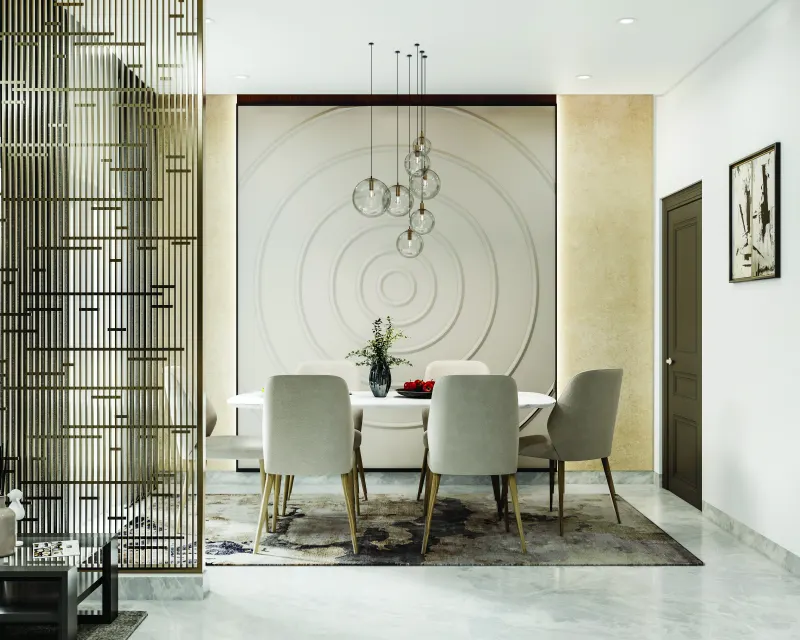
There's a practical bonus too: partitions can earn their footprint. Unlike a plain wall, a divider can hold your television on one side and crockery on the other, or double as a bookshelf, a pooja niche, or a shoe cabinet at the entrance. You're not spending space to separate rooms — you're getting storage and separation from the same structure.
The 7 partition types worth knowing
Most designs are a variation on these seven. Knowing the family helps you brief a designer precisely instead of scrolling endless photos.
Wooden slat & louvre
Vertical timber or ply fins on a frame. Warm, semi-open, hides the room beyond without blocking light. The safe, always-in-style choice.
Glass partition
Clear, frosted or fluted toughened glass, framed or frameless. Divides sound and mess while keeping both zones bright and visually connected.
CNC jaali screen
Laser-cut MDF, ply or metal in geometric or traditional patterns. A feature in itself; casts beautiful shadow play through the day.
Storage / TV-unit
A double-sided cabinet: TV and media on one face, crockery or books on the other. Separation plus serious storage in one build.
Sliding & folding
Panels that glide or fold away. Open two rooms into one for gatherings, then close them for everyday use. Ideal for small homes.
Planter & open-shelf
Open racks holding plants, décor and books. Airy, informal, and the least visually heavy way to suggest a boundary.
Pony / half-wall
A low wall or unit topped with a counter, railing or slats. Defines a zone while keeping the whole space in one glance.
Materials & finishes that last in Indian homes
The prettiest partition fails fast if the core material can't handle heat, humidity and daily knocks. Here's how the common options actually behave.
| Material | Best for | Lifespan | Notes |
|---|---|---|---|
| BWP / BWR plywood | Structural & storage partitions | 15–20 yrs | Waterproof grade, holds hardware well, takes laminate or veneer |
| MDF | CNC jaali, decorative screens | 8–12 yrs | Smooth for intricate cutting; keep away from wet zones |
| Toughened glass | Light-flow dividers | 15+ yrs | Safe if it breaks; frosted/fluted adds privacy |
| Solid wood | Premium heritage looks | 25+ yrs | 2–3× the cost of ply; needs seasoning & care |
| Metal (MS/brass) | Slim frames, art screens | 20+ yrs | Powder-coat MS to prevent rust in humid areas |
On finishes: laminate is the workhorse — hundreds of shades, scratch-resistant, wipe-clean. Veneer gives real-wood warmth at a premium. PU and Duco paint deliver a smooth, high-end matte or gloss but cost more and take longer. For a modern partition design, most Bangalore homeowners land on a laminate or veneer ply core with a slim metal or fluted-glass accent.
2026 partition cost guide (Bangalore)
Prices assume factory-made, site-installed units with standard hardware. Your quote shifts with size, finish and complexity.
| Partition type | Typical size | 2026 price range |
|---|---|---|
| Half-wall (ply + laminate) | 4–5 ft wide | ₹12,000 – ₹25,000 |
| Wooden slat / louvre screen | Full height | ₹22,000 – ₹55,000 |
| CNC jaali (MDF) | Full height | ₹350 – ₹900 / sq ft |
| Glass partition (framed) | Full height | ₹55,000 – ₹1,50,000 |
| Storage / TV-unit partition | 6–8 ft wide | ₹85,000 – ₹2,20,000 |
| Sliding / folding system | Per opening | ₹40,000 – ₹1,10,000 |
Get a free 3D partition design
Tell us your space. Our designers will send a 3D visual and an item-wise quote — before you pay anything.
Partition ideas by room
Every room asks a slightly different question of a divider. Here's the short version — each links to a full room guide.
Hall & entrance
The hall sets the first impression and usually needs to screen the living area from the front door. Jaali screens, slatted wood and pooja-integrated units shine here. See the full hall partition design guide.
Kitchen
Kitchen partitions manage smoke, mess and sightlines between cooking and living zones — glass, breakfast counters and semi-open dividers do the heavy lifting. Read the kitchen partition design guide.
Living room
Living rooms most often split from the dining area or an entry passage; TV-unit partitions, bookshelves and glass dividers are the go-to. Explore living room partition designs, and for open-plan homes, the modern living-and-dining partition guide.
5 mistakes to avoid
- Going too solid in a small home. A full-height opaque partition in a compact living-dining area kills the openness you paid for. Choose half-height or open designs.
- Ignoring circulation. A partition that narrows a walkway below 3 feet makes the home feel cramped. Map your movement before fixing a position.
- Cheap cores in wet zones. Particle board or plain MDF near the kitchen or a bathroom wall swells within a couple of years. Use BWP ply there.
- Forgetting the reverse face. A divider has two sides. Design both — a raw plywood back facing the dining table is a common, avoidable eyesore.
- Over-decorating. A busy CNC pattern next to busy wallpaper next to a patterned rug is visual noise. Let the partition be the feature, or let it recede — not both.
Partition design FAQs
What is the best material for a partition wall?
How much does a partition design cost in Bangalore?
What is the difference between a partition wall and a room divider?
Can a partition be used for storage?
Which partition is best for a small apartment?
Do partitions block natural light?
Ready to divide your space the smart way?
Free 3D design, factory-direct pricing, and a written quote before any advance.