On this page
In most Indian apartments the living room doesn't end at a wall — it dissolves into the dining area, or bumps up against the front-door passage. A living room partition gives that open space structure: it tells the eye where the sitting area stops and the dining begins, without building a wall that would darken the room and shrink it.
This is the living-room chapter of our partition design series. We'll look at why zoning matters, seven modern partition wall designs for the living room, how a TV unit can double as a divider, and the ever-popular living-and-dining split. For open-plan homes where the two truly share one space, see the focused living-and-dining partition guide.
Why zone the living room at all?
An undivided living-dining space can feel generous — or aimless, with the sofa and dining table floating in one undefined zone. A living room partition design gives each function a clear address. Done with a light hand, it makes the whole space feel considered rather than closing it off. The trick in Indian homes, where openness and light are prized, is to zone visually more than physically: a half-height unit, an open shelf or a glass screen signals the boundary while your eye — and the daylight — carries straight over it.
7 living room partition ideas
Double-sided TV unit
TV and media facing the sofa, display or storage facing the dining. Separation plus serious storage.
Open bookshelf divider
Ladder or box shelving for books, curios and plants. Zones the room while staying light and see-through.
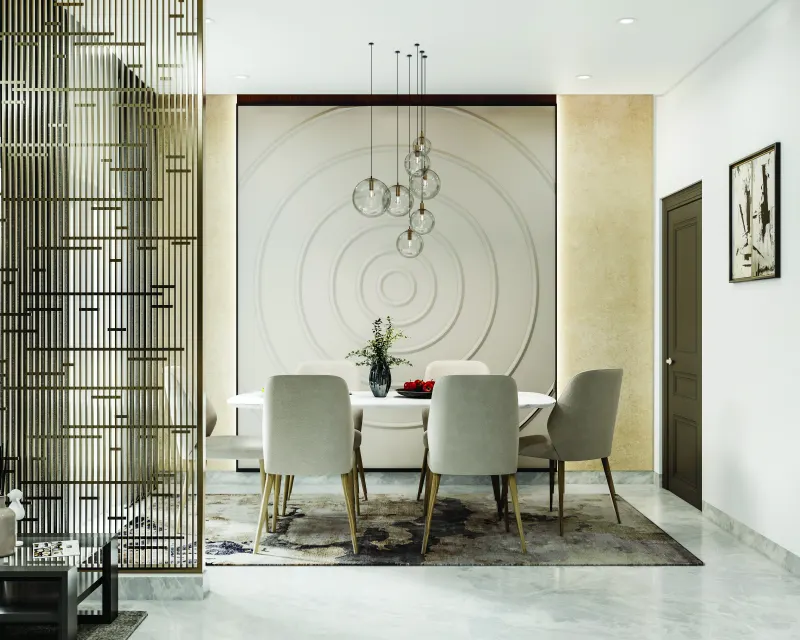
Fluted-glass screen
A slim glass panel that divides living from dining while keeping both bright. Frosted or fluted for softness.
CNC jaali screen
Laser-cut pattern in ply or MDF — a feature divider that throws lovely shadows across the living room.
Low half-wall
A pony wall topped with a wood ledge or slats. Marks the zone while keeping the whole room in one glance.
Metal-frame screen
Slim powder-coated metal with wood or glass inserts. The lightest, most contemporary way to divide.
Planter divider
A frame of integrated planters that softens the boundary and freshens the air between zones.
The TV-unit partition: the living room's workhorse
If one divider defines modern Indian living rooms, it's the double-sided TV unit. It solves two problems at once: it gives the television a home and it splits the living area from whatever sits behind it — usually the dining table or a passage. The living side carries the TV, a soundbar niche and closed media storage; the reverse becomes a crockery display, a bookshelf or shut cabinets for the dining zone. Because it's a single built unit, you get the divider "for free" alongside storage you'd have bought anyway. Keep it partial-height or add open shelving at the top if you want the room to still breathe.
Dividing the living and dining areas
The single most common living room partition job is the split from the dining space. Beyond the TV unit, three approaches suit different homes: an open bookshelf for a warm, informal boundary that still shares light; a fluted-glass screen for a bright, modern divide that blocks little but signals the change; and a low half-wall for the lightest touch, often topped with a slim counter that doubles as a serving ledge. In genuinely open-plan homes, keep the divider low and open so the two areas keep reading as one connected space — the subject of our dedicated modern living-and-dining partition guide.
Get a free 3D living room partition design
Share your living-dining layout and we'll send a 3D visual with an item-wise quote — before any advance.
Living room partition cost guide (2026, Bangalore)
| Design | Typical size | 2026 price |
|---|---|---|
| Open bookshelf / shelf divider | 4–6 ft | ₹20,000 – ₹55,000 |
| Low half-wall | 4–5 ft | ₹18,000 – ₹45,000 |
| Fluted-glass screen (framed) | Full height | ₹45,000 – ₹1,10,000 |
| CNC jaali (MDF) | Per sq ft | ₹350 – ₹900 |
| Double-sided TV-unit partition | 6–8 ft | ₹70,000 – ₹2,00,000 |
Living room partition FAQs
What is the best partition for a living room?
How much does a living room partition cost in Bangalore?
How do I divide a living and dining room?
Can a TV unit act as a living room partition?
What is a modern living room partition?
Which partition suits a small living room?
Give your living room a shape it deserves
Free 3D design and factory-direct pricing from Huma Interiors, Bangalore.